“Brief Encounter” in “A Touch of Class,” “84 Charing Cross Road,” and “Truly Madly Deeply”

The 1945 British film Brief Encounter — directed by David Lean, screenplay by Noel Coward, based on his play — may hold the record for the movie that’s watched in the greatest number of other movies. In addition to the three examples discussed in this post, IMDB’s valuable (though sometimes overpopulated) “Connections” department lists it as being featured in The Mirror Has Two Faces, Till There Was You, and Brick Lane, as well as the TV movies The Heidi Chronicles, Daisies in December, and The Care and Handling of Roses, plus various television episodes.

Why the attraction? It’s not simply that Brief Encounter is a classic. (In 1999, the British Film Institute voted it that country’s second best movie of all time, behind only The Third Man.) Beyond that, the film, with its thoroughly decent, stiff-upper-lip, and ultimately self-sacrificing lovers — the black-and-white photography being a kind of spartan objective correlative — is an emblem for a certain vision of romance, and thus a counterpoint to (and occasionally model for) the many, many other kinds of romance that movies portray.

In Melvin Frank’s A Touch of Class (1973), the contrast couldn’t be starker. After meeting cute what seems like eleven times, the characters played by the startlingly young, slim, sharply dressed, and good-looking Glenda Jackson (Vickie) and George Segal (Steve) embark on a strictly-for-sex affair. In Brief Encounter both of the lovers are married, but here Vickie is divorced, which hints at the unequal dynamics at play. Steve wants to have it both ways, which is in keeping with his me-me-me sense of the world; he’s always shown scurrying off from the opera intermission to shtup Vickie at their love nest, then hurrying back to his seat next to his wife before the end of the next act. The puzzlement of the movie is why Vickie — who, as a Glenda Jackson character, is required to be clear-eyed and intelligent — doesn’t dump Steve.

The answer — that she has fallen in love with him, and he with her — is supplied in the movie-in-movie scene, in which they watch Trevor Howard breaks bad news to Celia Johnson. The scene is asked to do the work that’s absent in the screenplay, their boo-hooing supposedly showing the relationship has reached a new level of intimacy and care. Then the alarm rings, and Steve scurries back to his family.

David Jones’s 84 Charing Cross Road (1987) is about an American writer, played by Anne Bancroft, who carries on a two-decade correspondence (1950s and ’60s) with the buyer at a London bookshop, played by Anthony Hopkins. He’s married and they never meet; the love that Brief Encounter reflects is her Anglophilia. Her fascination with the film seems to extend to the ash of her cigarette (yes, young’uns, smoking in cinemas used to be allowed), curling and lengthening but so wrapped up in the oh-so-Englishness of the movie that it doesn’t drop.

And now for something different, Anthony Minghella’s 1990 film Truly Madly Deeply. The love story here is between Nina (Juliet Stevenson) and her  boyfriend, Jamie (Alan Rickman), who keeps turning up even though he is dead. But this is no Ghost: Jamie is sniffling, needy, and annoying. And so are his movie-buff mates, who show up at en masse, wrap themselves in cozy duvets, and make trainspotting comments while watching the 1917 Charlie Chaplin comedy Easy Street. (Like many movie buffs, myself include, they are prone to error; one guy identifies the big comic as “Eric Stewart Campbell”; in fact, his given name was Alfred Eric Campbell. It is true that he died in a car crash shortly after making this film.)

The guys may be well-schooled in cinema, but they’re not too sophisticated to be wrapped up in Brief Encounter, reciting the final lines along with the Johnson character’s husband, and slow clapping their approval after “The End” rolls.
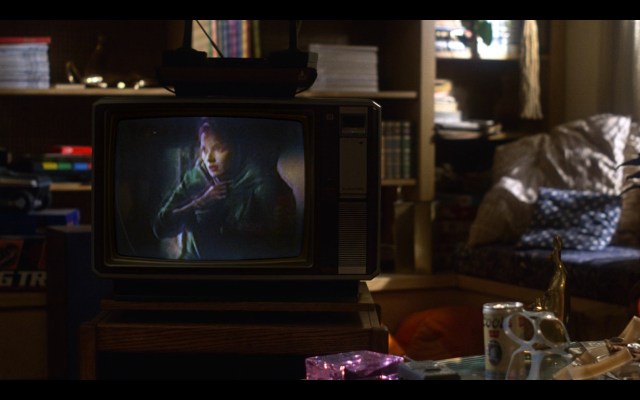


‘The Quiet Man’ in ‘E.T. the Extraterrestrial’

toshiba-blackstripe-tv-–-e.t.-the-extra-terrestrial-1982-3
Maureen O’Hara in “The Quiet Man”; can of Coors on the table.

Francis Ford Coppola, Brian De Palma, George Lucas, Martin Scorsese, and Steven Spielberg are sometimes known as “the film school generation.” De Palma and Spielberg didn’t actually go to film school, but the designation fits because all five are lifetime students and devotees of the directors and movies that came before them.

One of Spielberg’s heroes and mentors is John Ford (1894-1973). The younger director once said, “I try to rent a John Ford film … before I start every movie, simply because he inspires me … He’s like a classic painter:  he celebrates the frame, not just what’s inside it.” Spielberg offered his most explicit Ford homage in  E.T. the Extraterrestrial (1982). The scene is also an unusual one for Movies in Other Movies. Usually, the film-within-a-film provides an ironic counterpoint or commentary on the main action. But Spielberg veritably mirrors Ford.

The scene takes place early in the film. Young Elliott (Henry Thomas) has encountered, befriended, and brought to his room a lovable alien creature. Being a boy, Elliott has to go to school; E.T.,  left to his own devices, raids the fridge for food and beers. He also gets hold of a Speak & Spell, which Wikipedia calls “one of the earliest handheld electronic devices with a visual display to use interchangeable game cartridges. E. T. will eventually hack the device in his attempt to phone home. For now, he uses it both as a television remote control and, it seems, to mind-meld with Elliott.

(I’ll note here that E.T. includes other movies as well: E.T.  is horrified by the Tom and Jerry short “The Mouse Comes to Dinner” and watches the films This Island Earth and Michael the Brave; Elliott’s sister, Gertie, watches Sesame Street.)

Showing on the TV is a famous scene from Ford’s The Quiet Man (1953). In that movie, John Wayne plays Sean Thornton, an American returning to his ancestral Irish home. In the town, he spotted and become intrigued by a fiery (of course) redhead, Mary Kate Danaher (Maureen O’Hara). He buys a cottage and when he goes to inspect it, he comes upon Mary Kate, who’s been tidying up in a neighborly act. She’s scared and tries to run away, but he… Well, let’s watch along with E.T., who’s deeply affected by the scene and telepathically directs Elliott to reenact it (as well as to release biology-class frogs from imminent dissection).


To contemporary eyes, Sean’s romantic moves (and Elliott’s, too, for that matter) may seem a little grabby. On that point, I introduce the testimony of Sabienna Bowman, writing in the feminist magazine Bustle on the occasion of O’Hara’s death, in 2015 at the age of 95. Bowman says the kiss between Mary Kate and Sean is

not just the most memorable moment, but the one that is impossible to forget thanks to the passion O’Hara infuses into Mary Kate’s actions. To fully appreciate the scene, you must put yourself into a ’50s state of mind: Mary Kate enters Sean’s house unaccompanied (a huge taboo for an unmarried woman at the time) with the intent to clean it — but it is obvious she’s curious about this attractive American.

There is a moment when Sean realizes Mary Kate is in the house that she attempts to flee out into the raging winds. The cinematography only adds to the emotional rawness of the scene as Mary Kate’s red hair ripples in the wind and Sean snatches her arm and pulls her to him. It’s a typical move from the ’50s era idea of the perfect, bold American man that was Wayne, but it is Mary Kate’s response to his actions that makes this scene a classic. He pulls her in and kisses her, and then she throws a solid slap his way. It doesn’t land, but with her temper flaring and indignation written all over her face, O’Hara’s talent is breathtaking.

If you want to judge for yourself, here’s the full scene from The Quiet Man.


‘Stagecoach,’ ‘Angel and the Badman,’ and ‘Fort Apache’ in ‘The Apartment’

Billy Wilder’s The Apartment (1960) marks the director’s third appearance in this blog, for the moment passing Alfred Hitchcock (Sabotoge and Saboteur) in the top spot. (Wilder’s previous two entries were Sunset Boulevard and Witness for the Prosecution.)

Apartment_60The Apartment, which won Oscars for Best Picture, Best Director, and Best Original Screenplay (by Wilder and I.A.L. Diamond), was presented as a comedy that mocked romantic mores and man-in-the-gray-flannel-suit corporate culture, with its notorious attachment to the suffix “-wise.” But removed from its turn-of-the-decade context, and especially viewed in the light of the Me-Too movement, the film is chilling.
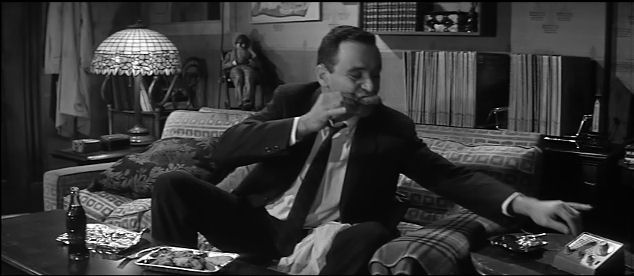
C.C. Baxter (Jack Lemmon), a peon in mammoth Consolidated Life Corp., has pimped out his Upper West Side apartment: he lets a quintet of executives use it for their trysts with secretaries and other female prey, in exchange for vague promises of corporate advancement. His neighbors, hearing the all-hours mayhem but unaware of the arrangement, think he’s a wild and crazy guy! Pretty funny! (Adding to the comic feel, inadvertently, is the fact that the five execs would go on to become staples of 1960s sitcoms: Fred MacMurray in My Three Sons, Ray Walston as My Favorite Martian, David White in Bewitched, and Willard Waterman on Dennis the Menace. David Lewis, meanwhile, played Warden Crichton on Batman, Senator Ames on The Farmer’s Daughter, and three separate roles on The Adventures of Ozzie and Harriet.)

The movie-in-movie scene comes early. The Lewis character has stayed on past the agreed-upon-time, forcing Baxter to roam the chilly New York streets, his body hunched in the classic Jack Lemmon slouch, his tan cotton raincoat turned up around his neck. When he can finally return, he heats up a TV dinner, brings it to the couch, and turns on the TV using a remote control, unusual at the time.

remote

BTW, I got the above image from an online discussion about the remote control in The Apartment, which suggests that any topic, no matter how obscure — or maybe the more obscure, the better — has its own online forum.

When the TV comes on, it shows an unctuous host announcing an imminent showing of the 1932 melodrama Grand Hotel, which Baxter seems to be happy about, maybe because its high-gloss world promises a complete escape from his own sordid one. But then the host presents a word from “our sponsor” and Baxter starts clicking. He successively lands on three different channels showing three different movies. (That is an anachronism. I lived in the New York television market in 1960 and can attest that it wouldn’t have happen that four channels would have movies on at the same time.)

Those three films are all John Wayne oaters: Stagecoach (1939), Angel and the Badman (1947), and Fort Apache (1948). The first and third were directed by John Ford, and I imagine Wilder, a German refugee who never made a Western, had in mind a subtle homage to that great Hollywood movie maker, different from him in just about every way.  The scenes that come on Baxter’s screen are all gunfights and bar fights and galloping cavalry, however, which are too much for his nerves at the moment. So he clicks back to Grand Hotel, hopefully. What he encounters actually is funny.


‘An Affair to Remember’ in ‘Sleepless in Seattle’

3-rosie-and-meg-sleepless
Rosie O’Donell and Meg Ryan bonding over “An Affair to Remember”

All movies are about movies, but Nora Ephron’s Sleepless in Seattle (1993) is about movies more than most. The characters habitually measure their own lives against what they’ve seen onscreen. Sam (Tom Hanks), a recently widowed architect, thinks about inviting a potential date over to look at swatches, but then muses that Cary Grant wouldn’t be caught dead looking at swatches with a woman. His ten-year-old son, Jonah, asks whether Sam will have sex with the swatch-woman; Sam, in a rookie move, says yes. Jonah tells him to be careful: “In movies, women are always scratching up the man’s back and screaming.”

All told, the words “movie” or “movies” appear fifteen times in Ephron’s screenplay.

The most movie-obsessed character, by far, is Annie (Meg Ryan), whom we see in an early scene watching An Affair To Remember (1957), starring the aforementioned Grant, on TV with her best friend, Becky (Rosie O’Donnell). After some portentous dialogue between the impossibly handsome and tanned Grant and Deborah Kerr, Annie laments, “Those were the days when people knew how to be in love…. It was right. It was real. It was …”

Becky breaks in: “… a movie. That’s your problem. You don’t want to be in love. You want to be in love in a movie.”

In a clever conceit, all females in this film are obsessed with An Affair to Remember, including an Empire State Building Security guard’s wife and Sam’s sister, Suzy (Rita Wilson), who can’t even summarize the plot without breaking into tears. Her husband, Greg (Victor Garber) teams up with Sam for a very funny response.

(In a piece of dialogue that apparently was cut from the shooting script, a detective Annie has hired to stalk Sam says she reminds him of “Glenn Close in that movie,” i.e., Fatal Attraction.)

Ephron has movies on her mind too: Sleepless is a love letter not so much to the ’50s women’s picture weepy An Affair to Remember as to the classic screwball comedies of the ’30s and early ’40s, the best of which, like Bringing Up Baby and His Girl Friday, featured Grant. Bill Pullman plays the Ralph Bellamy role–the well-meaning but terminally dull fiancee Walter. Ryan’s a reporter, like Rosalind Russell in Friday and Barbara Stanwyck in Meet John Doe. And Hanks and Ryan are the impossibly good-looking (though not tanned) leads, whose love has a supernatural sway over the actions and intentions of mere mortals. Just like in the movies.

(The clip below starts with the movie-on-movie scene, which ends at about the 2:30 mark. Because of technical difficulties, I was unable to trim the rest of the clip. It doesn’t have any movie-watching stuff, but it’s pretty good. In fact, I recommend watching the whole movie if you haven’t seen it recently. As of last week it was streaming for free on Verizon Fios On Demand.)