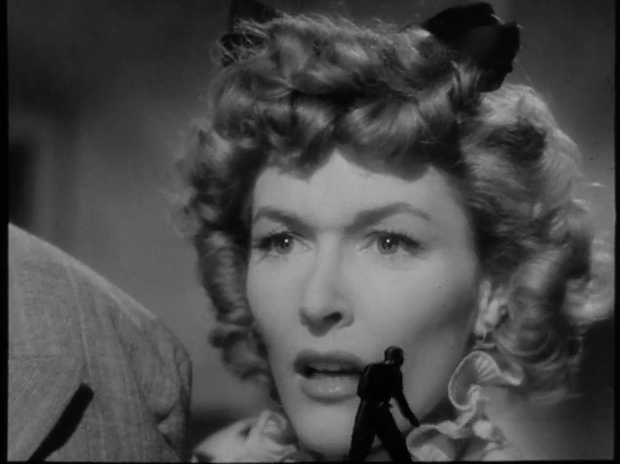
“Queen Kelly” in “Sunset Boulevard”

sunset

Billy Wilder’s Sunset Boulevard (1950) is probably the most movie-besotted movie of all time. Start with the premise. Gloria Swanson, a silent-film star whose career was derailed by the talkies, is Norma Desmond, a silent-film star whose career was ended by the talkies. Her card-game buddies are played by Buster Keaton, Anna Q. Nilsson, and H.B. Warner, all silent-screen stars of yore. Her butler-chauffeur, Max, turns out to be a once-acclaimed silent-film director and Norma’s ex-husband. He’s creepily–and brilliantly–played by Erich von Stroheim, a once-acclaimed silent-film director who’d been reduced to playing character parts, mostly Nazis in World War II-pictures. One of the few Hollywood folk who successfully made the silent-to-talkie transition was director Cecil B. DeMille. Surprise! He turns up as himself. We see him on the set of Samson and Delilah, which was released in 1949. According to IMDB, “Set elements and costumes from … Samson and Delilah were pulled out of storage, and cast members from that film re-hired, to re-create his filming.”

The most meta scene comes shortly after screenwriter Joe Gillis (William Holden) takes up residence in Norma’s decrepit mansion, where he serves as a combination amanuensis/boy toy. He tells us (there’s voice-over narration by Joe throughout) that Norma throws regular movie nights, just for the two of them; Max is projectionist. The repertoire, of course, is her own films. We see a bit from one of them, a scene where the young Norma’s face is illuminated by candles.

The clip is from Queen Kelly, a 1929 film that, more than any other single factor, derailed the careers of Swanson (the star) and von Stroheim, the director. At least he was the director until producer Joseph Kennnedy (Swanson’s lover and JFK’s father) fired him because the scenes he’d produced were too explicit and dark. Because von Stroheim retained the rights for what he’d shot, the film had never seen in the United States–until Sunset Boulevard.

The film, of course, is silent. As Norma tells Joe, “We didn’t need dialogue. We had faces.”
 

“Vertigo” in “Twelve Monkeys”

marquee

Terry Gilliam’s 1995 dystopian time-travel thriller Twelve Monkeys begins in the year 2035. We gradually learn that a virus released in 1996 killed off almost all of the world’s population. One of the underground-dwelling survivors, James Cole (Bruce Willis), is sent back in time to the 1990s to try to gather information about the outbreak. He winds up in an insane asylum, where his claims that he has come from the future don’t go over too well.

The TV-in-the-day-room is an essential fixture of such scenes, from One Flew Over the Cuckoo’s Nest on down. Often, mindless chirpy fare on the set comments on the grim reality before us. That’s the case in Twelve Monkeys, where, in addition, everything playing on the TV relates to animals. We successively see three 1940s Tex Avery cartoons:  “Swing Shift Cinderella,” “Little Tinker,” and “Who Killed Who.” We also glimpse a segment from “Horizon: The Cruel Choice,” a 1983 British documentary on animal experimentation (a theme of Twelve Monkeys), which itself includes a clip from the movie The Andromeda Strain. Then, to hit the monkey theme home, the Marx Brothers’ Monkey Business briefly comes on. (It’s heard more than seen.)

In a later scene, a television is playing “Prehistoric Super Salesman,” a 1969 cartoon. IMDB’s plot description: “Woody Woodpecker is sent back to the stone age by a mad scientist and his time tunnel.”

But the  big set-piece movie-in-movie scene comes late in the film, when circumstances have started to crowd in on Cole and Kathryn Railly (Madeleine Stowe), a psychiatrist he encounters in one of his visits to 1996 and who becomes his companion on the mission he comes to believe is his destiny.

The segment begins with full-screen view of a scene from Alfred Hitchcock’s Vertigo (1958) in which the characters played by Jimmy Stewart and Kim Novak are strolling among California redwoods. The dreamy Novak, who imagines herself the reincarnation of a nineteenth-century woman, points out “my” life span on an ancient tree’s rings; the parallels with Twelve Monkeys’ time traveling is clear.

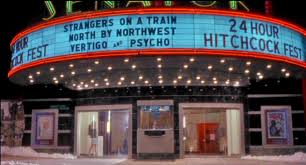
We cut away to see Cole and Kathryn sitting in a Philadelphia movie theater that’s showing a 24-hour Hitchcock marathon also including (a marquee tells us) Strangers on a Train, North by Northwest, and Psycho. The parallels to Vertigo multiply. Cole say, “I think I’ve seen this movie before, when I was a kid.” And right after he says the word “before,” Stewart asks Novak (whose present-day character is named Madeleine, just like Stowe), “Have you been here before?”

Cole is mesmerized by the movie, and gets at a striking comparison: that watching a film at different times in your life might be similar to keeping on going back in time to the same moment.

It’s just like what’s happening with us. The movie never changes. It can’t change. But every time you see it, it seems different, because you’re different.

Then someone in the sparse audience shushes him, a nice touch.

The next thing Cole knows, he wakes up alone in the theater, wearing a wig and fake mustache. On the screen is yet another Hitchcock movie, The Birds, reinforcing the animals-run-amuk thread of Twelve Monkeys. He runs out to the lobby and it’s almost as if we’ve literally stepped into Vertigo. Kathryn has on a blonde wig (making her look like so many Hitchock heroines) and actually is wearing the same style of coat Novak wears in Vertigo. At the moment when Cole sees her, the soundtrack is part of Bernard Herrmann’s Vertigo score.

On the Twelve Monkeys director’s commentary, Gilliam describes how things got bizarre when he and his team looked at the scene from which they mined the music.

We discovered that the cuts between Kim and Jimmy Stewart are identical to the cuts between Madeleine and Bruce. Then it got even stranger. The scene [in Vertigo] ends when they embrace and the whole room turns around them…. The foyer of the cinema [in Twelve Monkeys] is circular. We put them on a a turntable and the whole room spins around them.

That scene was eventually cut out. Still, Gilliam says, “It was almost as if the ghost of Hitchcock was making this section of the film.”


Untitled Melodrama in ‘Saboteur’

In 1942, six years after Sabotage, Alfred Hitchcock made the similarly titled Saboteur. But so much had changed. Hitchcock was now based in America, and Saboteur–an earlier-day North By Northwest, in a number of ways–was his first film to exploit the landmarks of what would become his adopted country, including Boulder Dam, the Statue of Liberty, and, in the movie-in-movie scene, Radio City Music Hall.

The main character, competently played by Robert Cummings, works in a munitions plant in Los Angeles (which in the movie is always pronounced “Los Angle-ese,” the way I remember the baseball announcers of my youth saying it). Falsely accused of setting a fire, he goes on the lam and eventually crosses the country, along the way finding the real Fifth Columnists.

One of the traitors is played by Norman Lloyd, whose career has stretched from his debut on the New York stage in 1933 to a role in 2015’s Trainwreck (and included a memorable turn as Dr. Auschlander in the 1980s medical drama St. Elsewhere). The cops are on to him and track him down in Radio City, filled with folks watching a melodrama.


It’s a great set piece but a strange one. The audience is tittering, then laughing uproariously, at the film on the big screen (which isn’t a real movie but a scene shot by Hitchcock with B-list actors), even after jealous-husband Henry pulls out a gun and threatens to use it. At that very moment, the Lloyd character, cornered by the cops and hiding behind the movie screen, shoots through it with terrible consequences. Henry starts shooting, but the audience incongruously keeps  roaring with laughter–until a woman screams. Lloyd moves in front of the screen and darts across it, creating a riveting image that may have been Hitchcock’s most self-conscious commentary on reality and artifice and terror, and how mixed up they can become.

Screen Shot 2017-12-16 at 5.22.48 PM


“Who Killed Cock Robin?” in “Sabotage”

A broad theme of this blog is the way in which cinema is about cinema. Alfred Hitchcock’s Sabotage (1936) is in large part about a cinema, The Bijou, which the main characters–the Verloc family–own and operate, next to which they live, and where a good deal of the action takes place. That’s one (of many) departures from the source material, Joseph Conrad’s 1907 novel, The Secret Agent. What both book and film share is that Verloc is a saboteur, his wife and her younger brother are unaware of that, and a bomb explosion is at the center of the plot.

(Spoiler alert.) In the film, Verloc (Oskar Homolka) gives his wife’s young brother Stevie the bomb, hidden in a bird cage, along with film canisters labeled Bartholomew the Strangler–another meta touch, as no such film exists. He gets on a bus and is supposed to drop the package off at an appointed spot at 1:30. The audience knows the bomb is set to detonate at 1:45, and, in the first great Hitchcockian set piece, we watch with mounting suspense and horror as the bus is delayed and the clock ticks ever closer to the fateful time. It finally arrives, the bomb goes off, and Stevie is killed.

In their sitting room next to the Bijou, Verloc confesses to his wife (Sylvia Sidney) what happened, trying to excuse his role in the tragedy. In a state of shock, she walks out and into the theater and the sound of laughter. The audience — mostly children — are watching the 1935 Disney short “Who Killed Cock Robin?” in which the robin, crooning a la Bing Crosby, is serenading a wren who talks and looks like Mae West. For a moment, Mrs. Verloc joins in the laughter, and it seems that the lesson might be the same as in Sullivan’s Travelsthe transporting and redemptive quality of silly comedy.

But then an arrow is shot and strikes Cock Robin, who falls to the ground, apparently dead. The spell is broken, and Mrs. Verloc’s face, in closeup, literally falls. She is back to her real-life world of mourning and pain.

“Myrt and Marge” in “O Brother, Where Art Thou?”

I would be remiss if I didn’t follow a post on Sullivan’s Travels with one on the movie that has the same name as the movie the title character in that film starts out wanting to make. It’s not just the name. Director and (with his brother Ethan) cowriter Joel Coen said of O Brother, Where Art Thou? (2000), “In our mind, it’s the movie he would have made if he had the chance.”

Well, not really. Sullivan wanted to produce a stirring social document and O Brother, though it’s serious at heart, is a comedy. But the Coens’ movie is chock full of allusions and references to all sorts of texts, primarily to The Odyssey, secondarily to Sullivan’s Travels.

In the Sturges film, Sully ends up a prisoner on a chain gang. In O Brother, the three protagonists–Everett (George Clooney), Pete (John Turturro), and Delmer (Tim Blake Nelson)–start out that way but escape before the movie is five minutes old. Eventually, Pete, recaptured, gets taken with his fellow prisoners to a picture show, as in Sullivan’s Travels. Also watching the movie are his still-on-the-lam buddies.

The Coen brothers being the Coen brothers, the movie they chose as the feature attraction is about as obscure as it is possible to be: Myrt and Marge (1933), a pre-code backstage musical based on a popular radio serial. (The director, Al Boasberg, had writing credits on the Buster Keaton films The General, Dough Boys, and Battling Butler.) The Three Stooges had featured roles–another self-reflexive commentary, as Delmer, Pete, and Everett engage in some pretty prime slapstick themselves. (And are none too bright).

The Stooges don’t appear in the scene the boys watchor, rather, that serves as backdrop for Everett’s musings on the perfidy of women and his and Delmer’s stage-whispered communication with Pete, who it turns out has not turned into a toad. In fact, they don’t appear to even notice what’s on the screen. In contrast to Sullivan’s Travels, here the movie-watching experience is less than transformative.

If we care to, we can see and hear the scene–an audition in which Marge (Donna Dameral) strips off her skirt and displays the bizarre calisthenics of which she is capable. It’s implicitly another reference back to Sullivan’s Travels: Myrt and Marge is precisely the sort of lightweight entertainment Sullivan has made a fortune producing and, as the film begins, has turned his back on.


“Playful Pluto” in “Sullivan’s Travels”

Preston Sturges’s Sullivan’s Travels (1941) is one of the most meta movies that came out of Hollywood, at least before post-modernism reared its self-conscious head. It opens with an action scene–a fistfight on top of a train, with both protagonists falling to a watery grave. But then, the words “The End” appear in the water–it was only a movie. Three men get up from their screening-room seats, and one of them, director John L. Sullivan (Joel McCrea), argues to two studio execs that what they and we have just seen is just the sort of socially conscious document Depression American needs.

Sullivan (aka Sully) is ashamed of the escapist fare that has made him rich–trifles like Ants in Your Plants of 1939, Hey Hey in the Hayloft, and So Long Sarong. (Either the last is an amazing coincidence or Sturges knew that Pardon My Sarong, starring Abbott and Costello, was in production and would be released the following year.) He wants to make a film called O Brother, Where Art Thou?

Sullivan: I want this picture to be a commentary on modern conditions. Stark realism. The problems that confront the average man!

Exec: But with a little sex in it.

Sullivan: A little, but I don’t want to stress it. I want this picture to be a document. I want to hold a mirror up to life. I want this to be a picture of dignity! A true canvas of the suffering of humanity!

Exec: But with a little sex in it.

Sullivan: [reluctantly] With a little sex in it.

Unfortunately, Sullivan, a product of boarding school, has no experience with the suffering of humanity, and therefore resolves to put on hobo clothes, go out on the road, and obtain some. Complications ensue, notably involving Veronica Lake, identified in the credits only as The Girl. “How does the girl fit into the picture?” a cop asks Sully. He says, “There’s always a girl in the picture. What’s the matter, don’t you go to the movies?”

There’s lots of other self-referential lines, including knowing mentions of Sturges’ colleagues Frank Capra and Ernst Lubitsch. At one point, Sully, in trouble yet again, breaks the fourth wall, remarking, “If ever a plot needed a twist, this one does.”

The movie can be said to be structured around three movie-watching scenes. The first is the fight sequence that opens things up. The second comes when Sully is taken in, and taken to a picture show, by two maiden ladies. Here the camera stays on the audience and all we get from the movie is some lachrymose music–the dialogue is drowned out by the sounds of kids sniffling and people munching on snacks, all combining to give the sense of a pretty miserable cinematic experience. As Sully and his companions leave, we see from a lobby card that a triple bill is playing: Beyond these Tears, The Valley of the Shadow, and The Buzzard of Berlin.

The third movie-within-the-movie is the climactic scene of Sullivan’s Travels, and the only one that’s an actual movie. Through plot machinations, Sullivan has found himself a prisoner on a chain gang, subject to miserable conditions. For a rare respite, the prisoners are brought to a rural African-American church, where a movie is projected on a white sheet that serves as a makeshift screen. The selection of the day is a 1934 slapstick (rather Warner Brothers-y, in fact) Disney short, “Playful Pluto.” As Sully watches, he begins to have a revelation.


Through more plot machinations, he is released. News of his adventures have created a nationwide sensation, and the studio execs are now eager to make O Brother, Where Art Thou?  One of them says, “It will put Shakespeare back with the shipping news!”

But Sully will have none of it. He wants to make a comedy. He says, as the picture comes to and end, “There’s a lot to be said for making people laugh. Did you know that’s all some people have? It isn’t much but it’s better than nothing in this cockeyed caravan.”