Silent Round-up, Part II: ‘Souls for Sale,’ ‘Tramp, Tramp, Tramp’

Souls for Sale (1923) takes the comic premise of Mabel’s Dramatic Adventure seriously, and elongates it to feature length. Written and directed by Rupert Hughes (Howard’s uncle), the film also anticipates What Price Hollywood? (1932) and A Star Is Born (1937) and its sequels in telling the story of a young woman’s arrival in Hollywood and rise to stardom. The woman is named Remember “Mem” Steddon (Eleanor Boardman), and her arrival is by a circuitous route, including her honeymoon escape from her nogoodnik husband, played by Lew Cody.

A friendly actress (Barbara La Marr) helps her snag a screen test, and here the two women, along with director Frank Claymore (Richard Dix) and male star Tom Holby (Frank Mayo) watch the results.

Well, Frank does make an actress of her, and, due to a freak injury suffered by the star of a new production, Mem steps into the lead role. (Shades of 42nd Street.) The (unnamed) film is successful enough to be screened as far away as Egypt. Who but nogoodnik husband should be in the in a private box, in the process (he thinks) of ensaring his latest victim, when he sees Mem on screen and nearly does a spit take.

In addition to these scenes and ones shot on-set (including a tour de force conclusion), Souls for Sale has (as Roger Ebert wrote in 2009, when a restored version of the film aired on TCM), “cameo roles showing Charles Chaplin directing a scene while puffing furiously on a cigarette, Erich von Stroheim allegedly working on “Greed” and such other stars as Barbara La Marr, Jean Hersholt, Chester Conklin and Claire Windsor.” All of this adds up to probably the first example of a film taking a serious look at movies and the industry that was growing up to turn them out.

Normally, I don’t write about examples of people watching newsreels (or TV news), but I’m including Tramp, Tramp, Tramp (1926) for the historical record. The film was directed by Harry Edwards and stars Harry Langdon as a guy who enters a cross-country walking race to impress a girl (Joan Crawford!). Apparently, the event is newsy enough to reach the theater frequented by Langdon’s father, played by Alec B. Francis.


Next: Show People and A Cottage on Dartmoor.
‘Meet Me in St. Louis’ in ‘The Family Stone’

This blog has an informal policy of not writing about cases where the movie-in-movie is significantly better than the “host” movie; I’ve called it the South Pacific/Welcome to Woop Woop Rule. I’ll make an exception in the case of Thomas Bezucha’s The Family Stone (2005). Why? Well, for one thing, both it and Vincente Minnelli’s Meet Me in St. Louis (1944) are holiday movies and we’re smack dab in the holiday season.

And the other thing is, I find the contrast between the two films interesting. Family Stone has the reputation of being a good movie. I just saw it for the first time and I beg to differ. I found it manipulative, mendacious, hollow, and believable for maybe forty-five seconds. I don’t want to pile on (after all it’s the holiday season) so I’ll just quote Manohla Dargis of the New York Times and move on: “Tolstoy didn’t know the Stones, who are happy in a Hollywood kind of way and unhappy in a self-help kind of way. This tribe of ravenous cannibals bares its excellent teeth at anyone who doesn’t accommodate the family’s preening self-regard.”

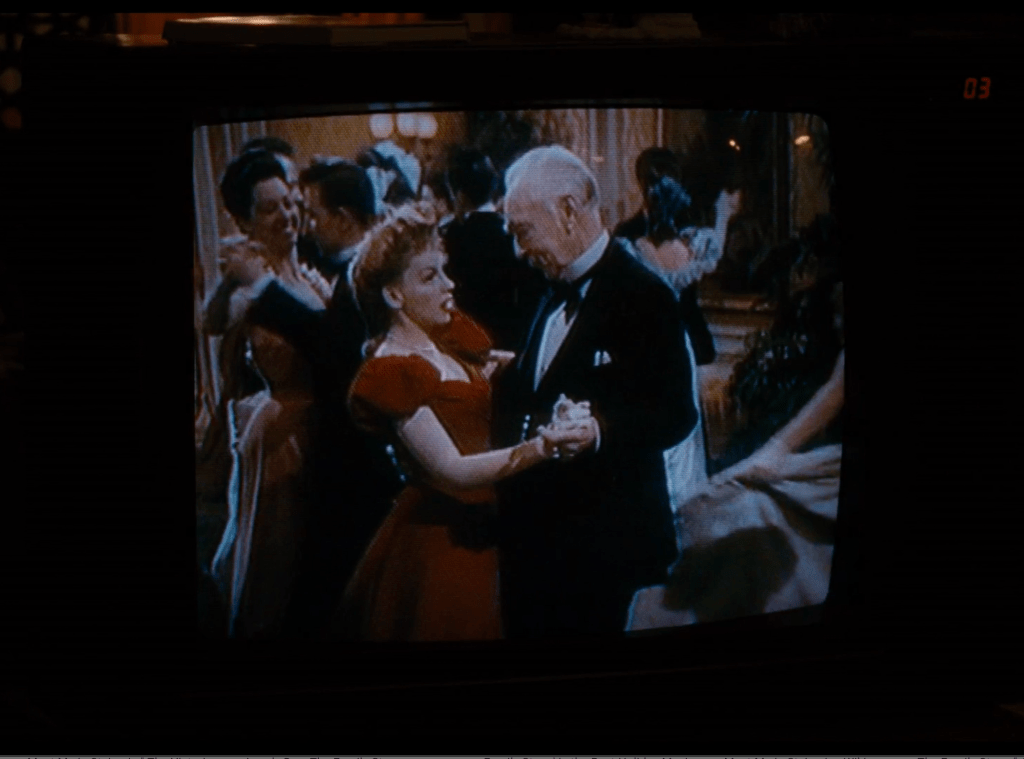
Meet Me in St. Louis really is a good movie, maybe a great one. And in this context maybe the most striking thing about it is its honest and affecting sentiment, as opposed to sentimentality. In this Family Stone Christmas Eve scene, Stone family daughter Susannah (Elizabeth Reaser) — who’s merely bland, not fake — tells her father, Kelly (Craig T. Nelson), that she’s not going to bed because her favorite scene is about to start. Esther (Judy Garland) is dancing with Grandpa (Harry Davenport), also on Christmas Eve.

Basically, The Family Stone is hijacking Meet Me in St. Louis for its emotion. The larceny continues, as we see a montage of the various characters conducting their various Christmas Eve activities, to the tune of the Meet Me In St. Louis song that many people (with justice) consider the best holiday song ever, “Have Yourself a Merry Little Christmas.”

I could go on to say that in addition to everything else, this violates what must be one of the dramatic unities, as in Minelli’s film, it’s sung before the dance scene. But who needs more carping from me? Merry Christmas, everybody.

‘Monster on the Campus’ in ‘Eternal Sunshine of the Spotless Mind’

Like a lot of people, I guess, I’ve been able over the last nine months or so to catch up with some (not enough) movies I somehow never got around to seeing. A few weeks ago, I watched Michel Gondry’s Eternal Sunshine of the Spotless Mind (2004) and enjoyed it quite a bit, including learning that the title is a quote from the 18th-century English poet Alexander Pope.

The movie has an ingenious premise and plot, which gradually reveals itself, so I’ll try to resist any spoilers, only say that in this scene, some ragtag scientists (played by Mark Rufalo, Tom Wilkinson and Kirsten Dunst) have hooked Joel (Jim Carrey) up to a machine that extracts memories, and thus the movie-in-movie scene is a flashback. Joel and Clementine (Kate Winslet) are at a drive-in — actually outside a drive-in — where for some reason the feature is a 1958 exploitation flick, Monster on the Campus. (IMDB plot summary: “The blood of a primitive fish exposed to gamma rays causes a benign research professor to regress to an ape-like, bloodthirsty prehistoric hominid.”)

Here’s a clip (you can ignore the opening seconds, where a tiny Carrey is submerged in a sink):

One notable thing about the scene is that, as Carrey improvises some Mystery Science Theater 3000-type dialogue to the absurd happenings on the screen, it’s the only moment in the film (as I recall) that he exercises his considerable comedy skills. Another is that, surprisingly enough, Monster on the Campus was never actually featured on MST3K–although, according to one fan of the show, it should have been.

‘Woodstock’ in ‘The Omega Man’; ‘Shrek’ in ‘I Am Legend’

Robert Neville (Charlton Heston) pulls up to the theater.

Boris Sagal’s The Omega Man (1971) was based on Richard Matheson’s 1954 novel I Am Legend. Wikipedia’s description of the book’s setting: ” a pandemic … has killed most of the human population and turned the remainder into ‘vampires’ that largely conform to their stereotypes in fiction and folklore: they are blood-sucking, pale-skinned, and nocturnal, though otherwise indistinguishable from normal humans.”

The protagonist, Robert Neville, appears to be the only survivor of the pandemic. He spends his days patrolling Los Angeles, looking to kill vampires with wooden stakes. and his nights inside his apartment, looking to stay alive. Matheson says that he occasionally screens movies for himself but doesn’t name them.

Sagal and screenwriters John William Corrington and Joyce Corrington decided to show Neville (Charlton Heston) actually watching a film — not at home but out in the world. (A previous film version was The Last Man on Earth, 1964, with Vincent Price — no movie in movie.) The present day of The Omega Man is 1977; the pandemic had hit seven years earlier, when Woodstock was playing in theaters. Neville, it appears, has developed an odd obsession with that documentary, perhaps because the utopian hippie dreams in it appear so quaint in the light of his harsh world.

He’s equipped one cinema with a generator. We see him power it up, spool the film in a projector, and watch it for the umpteenth time, his rifle lovingly cradled beside him.

His comment at the end of the clip is an example of a cliche made literal.

Matheson’s book got adapted again in 2007, under Francis Lawrence’s direction and with Will Smith as Neville. This time, his much-watched movie is Shrek, and he watches it at home with a mother and son with whom he’s joined forces. That mirrors the Shrek scene, where the characters voiced by Mike Myers and Eddie Murphy form an alliance of their own.

‘King Kong’ and ‘Rebecca’ in ‘The Cider House Rules’

p04rmn49

The Cider House Rules (1985) is my favorite John Irving novel, and I liked the 1999 film adaptation by Lasse Hallström a lot, too. Preparing this post made me appreciate a particular difference between the two versions. In the book, characters are always reading Victorian novels: Dickens’s David Copperfield, Little Dorritt, and Great Expectations, Charlotte Brontë’s Jane Eyre. That’s no coincidence, for Irving successfully (in my view) modeled his own book after these older works.

Skimming through the novel, which takes place during World War II, I find only one reference to a film. The main character, Homer Larch, who has been raised in a Maine orphanage run by the obstetrician Dr. Wilber Larch, goes to his first drive-in movie, also, judging by his reaction, his first movie of any kind.

… a gigantic image filled the sky. It is something’s mouth! thought Homer Wells. The camera backed, or rather, lurched away. Something’s head-a kind of horse! thought Homer Wells. It was a camel, actually, but Homer Wells had never seen a camel, or a picture of one; he thought it was a horribly deformed horse-a mutant horse! Perhaps some ghastly fetus-phase of a horse! The camera staggered back farther. Mounted by the camel’s grotesque hump was a black-skinned man almost entirely concealed in white wrapping-bandages! thought Homer Wells. The ferocious black Arab nomad brandished a frightening curved sword; whacking the lumbering camel with the flat of the blade, he drove the beast into a faulty, staggering gallop across such endless sand dunes that the animal and its rider were soon only a speck on the vast horizon. Suddenly, music! Homer jumped. Words! The titles, the names of the actors were written in the sand by an invisible hand.

It turns out to be a pirate picture, and the black man on the horse is never seen again, but Homer comes to identify with him–a Bedouin, a wanderer with no home. (And by the way, I assume Irving had a real pirate movie in mind, and I’d be interested in any thoughts or nominations for what it might have been.)

By contrast, the film version of Cider House (Irving won an Oscar for his screenplay) foregrounds movies. We’re given to understand that on movie night Dr. Larch (Michael Caine) screens the same film for the children and staff, because one movie, made way back in 1933 and showing a lot of wear and tear, is all he has has. Nobody, including Homer (Tobey Maguire), seems to mind.  In the clip, the movie scene starts at about the 1:45 mark.

Later, Fuzzy (the boy who says Kong thinks Fay Wray is his mother), ill and under a makeshift oxygen tent, has a private screening of King Kong.

Homer starts dating Candy Kendall (Charlize Theron) and we see them going to two movies, both starring Laurence Olivier. Here, they watch a scene from Rebecca (1940) where Olivier dances with Joan Fontaine. (The voice over is Dr. Larch, reciting a letter to Homer.)

Another time, they walk out of a theater having seen Wuthering Heights (1939), with Olivier and Merle Oberon, and discuss the movie. For not having seen many films, Homer shows himself to be a pretty sharp film critic.

CANDY
		(disappointed)
	But you looked as if you liked it.

			HOMER
		(smiling)
	I *did* like it. All I said was, 
	"It's not 'King Kong'."

‘Man or Woman’ and Other Coming Attractions in ‘A King in New York’

Screen Shot 2020-08-12 at 3.55.10 PM
Chaplin and rock-and-roll fans.

TCM recently had a Charlie Chaplin day in its annual “Summer Under the Stars” festival, and Michael Tisserand alerted me to a nifty sequence in A King in New York (1957), Chaplin’s second-to-last film and the last in which he appeared. (The final film he directed was A Countess from Hong Kong, in 1967.) He plays the king of a mythical country who is forced out by revolution; his name, Shahdav, suggests a reference to the Shah of Iran, who ruled from 1941 till 1979. Shadav’s destination is New York, just like Eddie Murphy’s African king in Coming to America (1988).

As students of cinema know, Chaplin went into semi-voluntary exile from the United States in 1952, not returning until 1972, when he received an honorary Academy Award. As a result, the satire or critique of U.S. culture, politics, and mores that constitutes a great deal of A King in New York is necessarily a bit second-hand. A lot of it is very sharp nonetheless.

In this scene, Shahdov has just arrived in the city and has a night to kill before attending to his principal business, going to a bank and withdrawing his country’s national treasury. Ambassador Jaume (Oliver Johnston) suggests taking in a movie. When they arrive at the theater, a rock-and-roll show is just finishing up. And here’s where a bit of second-hand feel comes in. The supposed rock music sounds more like ’40s hot jazz, and the latter-day bobby-soxers in the audience show their appreciation by clapping and full-throatedly cheering, as if they were at a baseball game; in reality, at least since Elvis’s ascent the year before, screams were de rigeur.

But the satire of movies, seen in the coming attractions, is absolutely on-point, and hilarious. No surprise there — forty years earlier, Chaplin had more or less invented popular cinema, and he had clearly kept a jaundiced eye on its fashions and conventions, notably poor marksmanship.

“I gotta kill ya, honey — it’s for your own good,” is rich.

‘The Charge at Feather River’ in ‘A Star is Born’ (and a lot more): Part I

By the time you get to the end of part III of this post, I hope you’ll agree with me that George Cukor’s A Star Is Born (1954) is the most movie-in-movie movie in the history of movies.

The first data point is relatively straightforward. Judy Garland plays Esther Blodgett, a small-time singer who has been taken under his wing by soon-to-be-fading movie star Norman Maine (James Mason), and is signed to a contract by studio chief Oliver Niles (Charles Bickford — and notable among the bullet points in the movie’s poetic license is that a mogul would be as WASPy as all that). On her whirlwind first day at the studio, even before her name is changed to Vicki Lester,  Esther is ushered in to see Niles as he’s screening a Western.

There are several things to say about the scene, first of all, that it’s great. Cukor’s (probably his decision more than screenwriter Moss Hart) choice of movie, The Charge at Feather River (1953), and segment within it is perfect. The fact that it was a real, current film adds verisimilitude; the screaming and general mayhem on view plays up Esther’s nervousness and discomfort, and in addition releases some of the host movie’s built-up tension. And it’s such a great contrast with Cukor’s über-woman’s picture (and I say that with admiration).

I’ll also note that both A Star Is Born and The  Charge at Feather River were Warner Brothers pictures, itself a data point in my hypothesis that, for economic reasons, a disproportionate percentage of host movies and “seen” movies come from the same studio.

But back to screaming: the Feather River scene is notable in having given the name to one of the most famous sound effects in Hollywood history, the Wilhelm Scream. The website cinemagumbo explains:

A simple sound effect—a man’s brief, agonizing cry while being attacked by an alligator—has become a Hollywood in-joke, a stock piece of audio for science fiction and western movies, a good luck charm for various filmmakers and has even inspired the name of a Massachusetts-based rock band.

The Wilhelm Scream, as the sound effect is known, was first used in the film Distant Drums (1951), which featured the aforementioned alligator attack (above). It is actually one of a series of six screams the movie’s sound department recorded with singer and actor Sheb Wooley at Warner Bros. Wooley’s distinctive “ah-AYE!-uh” was subsequently used for—and got its name from—The Charge at Feather River (1953), in which a character named Private Wilhelm is shot with an arrow.

The Wilhelm Scream is actually heard a second time in A Star is Born, in Garland’s  number “Someone at Last,” where it’s incongruously inserted as an “exotic” African effect (very poor taste now) in her round-the-world musical journey. Probably that was the start of the in-joke. It went on to become a favorite of George Lucas and Steven Spielberg, and is heard in every Indiana Jones movie and every Star Wars one through The Force Awakens (2015), when it was retired. On the off-chance you’re interested, here’s a compilation of some of the Wilhelm Scream’s Greatest Hits:


Next: The “Born in a Trunk” sequence.

‘The Cobweb’ in ‘Point Blank’

MV5BYTU3MjA5MTgtMmI0OS00OTY5LTk5NjYtZmRjNzMxNWJmYmMzXkEyXkFqcGdeQXVyMjUyNDk2ODc@._V1_
Dickinson and Marvin: her hair matches her dress.

Veteran film journalist Lewis Beale recommended my doing a post on John Boorman’s Point Blank (1967), which he describes as “simply an amazing mix of film noir, existentialism and Euro art-house filmmaking. Truly astonishing it was released by a major studio. My guess is audiences at the time said ‘WTF did I just see?'”

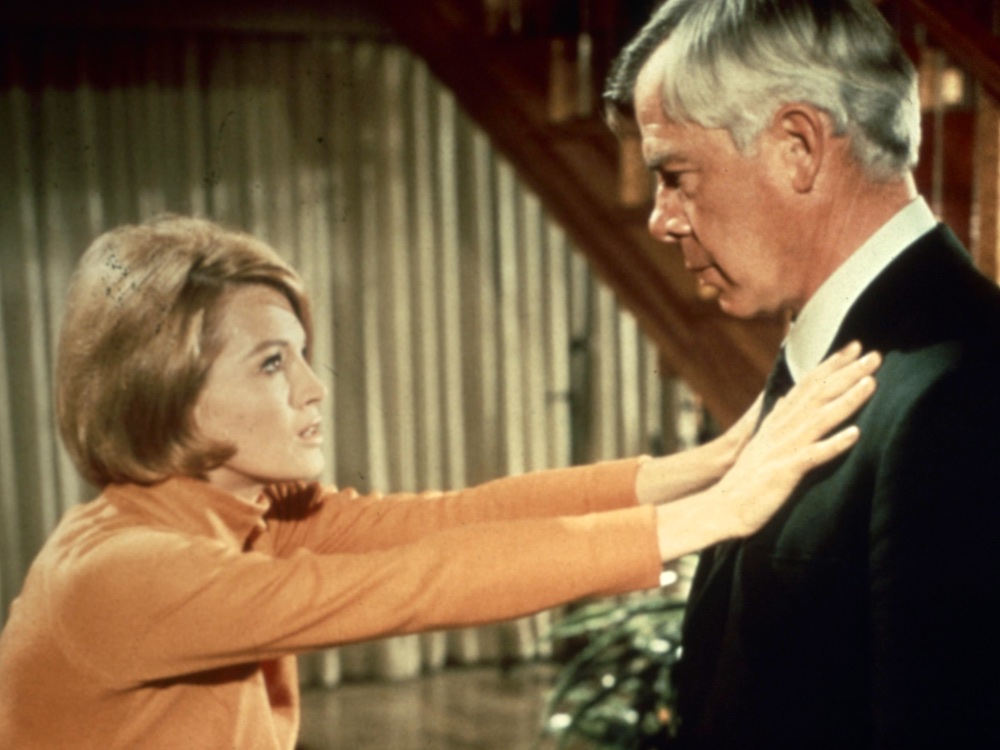
Good call, Lew. Let’s go right to the movie-in-movie scene, one of the WTF-est in Point Blank. Walker (Lee Marvin) is a criminal on a mission to recover a $93,000 MacGuffin, swiped from him after a heist. Angie Dickinson is his sister-in-law, Chris, who’s developed feelings for him and is infuriated that he won’t give up on his dangerous quest.

Whoa. Quite a bit to say about the scene, definitely starting with WTF. The third star is of course, the automated-to-the-max mid-century modern house, which is on 7655 Curson Terrace and was apparently rented by the Beatles in 1966, right about the time the film was shot.

In a 2008 Vanity Fair interview, John Boorman talked about Dickinson’s distinctive look.

I put her in the first miniskirt to hit America. They were already, you know, on the Kings Road in London, but she wore the first one seen in America…. [She] was very unhappy with me about forcing her to change her hair color. I had this maniacal idea that I wanted her hair to be the same color as her dress, and we went through three dyeing jobs to get there. The hairdresser at MGM said, “I can’t go any further, her hair’s starting to break off.”

As for her pummeling Marvin, it has been suggested that she got into it so passionately because she was mad that he (or his character) dangled her over a balcony in a previous film, The Killers. I’m not sure if that’s true but her performance is certainly convincing, and she definitely opened up a gash in Marvin’s cheek with the pool cue.

And here’s a video created by Peter van der Ham showing Dickinson blows scored with a Steve Reich piece called “Clapping Music.”

As for the movie-in-movie moment, it comes after Marvin is flipping channels with the remote control (as Jack Lemmon did in The Apartment), in keeping with the automated-house theme. He lands on Vincente Minelli’s The Cobweb (1955), an MGM (same studio as Point Blank) melodrama set in a psychiatric institution and with a remarkable cast: Richard Widmark, Charles Boyer, Lauren Bacall, Susan Strasberg, Oscar Levant, Lillian Gish, Gloria Grahame, and Fay Wray.

We see staff member Bacall (her back to the camera) talking with a patient played by John Kerr. When he says, “You figure this will get me over my neurotic intertia or something,” Marvin switches the channel to a Pond’s cold cream commercial

Understandable move.

‘Titanic’ in ‘Love, Actually’

When-Daniel-Sam-Share-Titanic-Moment

I am not especially a fan of either Titanic (1997) or Richard Curtis’s Love, Actually (2003). In fact, I’m probably one of the few sentient beings not to have watched either film in its entirety. But I had to do a post on this scene after getting a note from one of my all-time favorite students from my teaching career, Meghan Lobdell Gooding.

After I had shared a previous movie-in-movie post on Facebook, Meghan wrote:

I always enjoy when Liam Neeson and his step-son watch the “Jack, I’m flying!” scene from “Titanic” in the movie “Love, Actually” …because the Kate Winslet TV-within-a-TV-screen cameo fulfills my need for the complete foursome from the 1995 “Sense and Sensibility film”: Emma Thompson, Alan Rickman and Hugh Grant all star in Love Actually … Kate Winslet is the missing piece.

Seems this is one of the bits I missed in my disjointed viewings of Love, Actually, which at one time was on a lot in my house because various members of my family were fans. In honor of their and maybe Meghan’s feelings, I will refrain from discussing how young Sam (Thomas Sangster) is maybe just a little too cute for the circus, and how Curtis’s inclusion of what was then the highest-grossing film of all time was maybe a little on the nose.

I will say, however, that seeing Daniel (Neeson) and Sam act out Winslet and Leonardo DeCaprio’s ship-top scene from the earlier film inspired me to add a new tag, “Re-create,” previously seen in E.T. and Sherlock Jr.

Anyway, this one’s for you, Meghan.

Untitled MGM Cartoon in ‘Northwest Hounded Police’

I confess that until researching this post, I was unfamiliar with Tex Avery’s MGM cartoons. Like many people, I know and love the Warner Brothers stuff by Avery, Fritz Freling, and Chuck Jones — Bugs Bunny, Tweety Bird, Daffy Duck, and that lot. But I’ve learned that in 1941, Avery left Warner’s for MGM, where his greatest creation was the phlegmatic basset hound Droopy.

61JQvmAXqiL._SL1000_

Northwest Hounded Police (1946) is like a Road Runner cartoon not so much on steroids as mescaline. A prisoner up in the Yukon, Wolf, escapes and is pursued by a Mountie, Droopy. And I mean pursued. Wolf ventures to the highest mountain peak and the depths of the ocean, and as soon as he arrives, who should he see but the Droop-ster. Wolf does a double and usually a triple take, his eyes bulge out of his head by twenty feet or so, and he hightails it out of there at warp speed.

Both Warner’s and MGM cartoons were larded with self-conscious fourth-wall breaking, and indeed, such a joke was the reason for Avery’s leaving Warner’s. According to Wikipedia, in Avery’s original version of The Hunting Hare (1941)

Bugs and the hunting dog were to fall off a cliff three times, milking the gag to its comic extreme. According to a DVD commentary for the cartoon, the historian and animator Greg Ford explained that the problem [producer Leon] Schlesinger had with the ending was that, just before falling off the third time, Bugs and the dog were to turn to the screen, with Bugs saying “Hold on to your hats, folks, here we go again!”, a punchline to a potentially risqué joke of the day.

In the first scene in his first movie, Dumb-Hounded (1943), Droopy looks at the audience and says, “Hello, all you happy people … you know what? I’m the hero.”

Northwest Hounded Police offers a new level of meta, as Wolf literally runs out of the frame of the film and takes a seat in a movie theater, only to see …

If you’re interested in seven and a half minutes of fun, here’s the whole movie.

https://vimeo.com/230227767