‘Angels with Filthy Souls’ in ‘Home Alone’

Home Alone (1990; directed by Chris Columbus; conceived, written and produced by John Hughes) presses all the buttons. You’ve got your madcap humor, your cartoon violence, your patented John Hughes pathos, your upper-middle-class white Midwestern suburbanite setting, and (possibly the only element that still feels fresh and unpremeditated) your breakout performance by Macaulay Culkin as 8-year-old Kevin, who (it can’t be a spoiler if it’s the title of the movie) is inadvertently left home alone when his family flies to Paris for Christmas.

Ah yes, Christmas — that’s the other big button. Home Alone was conceived in and dedicated to the proposition of being a holiday movie. One way it establishes this is time-honored: having characters watch (on TV) Miracle on 34th Street, How the Grinch Stole Christmas, and of course It’s a Wonderful Life. (The last is seen by the Kevin-less clan while in Paris, and is dubbed into French.)

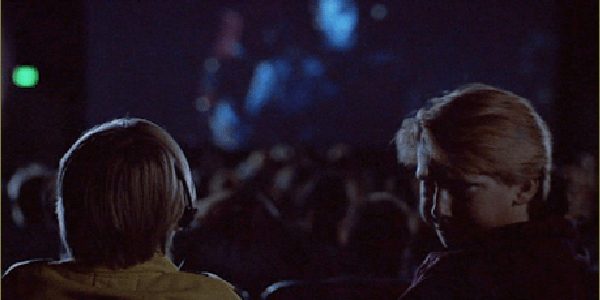
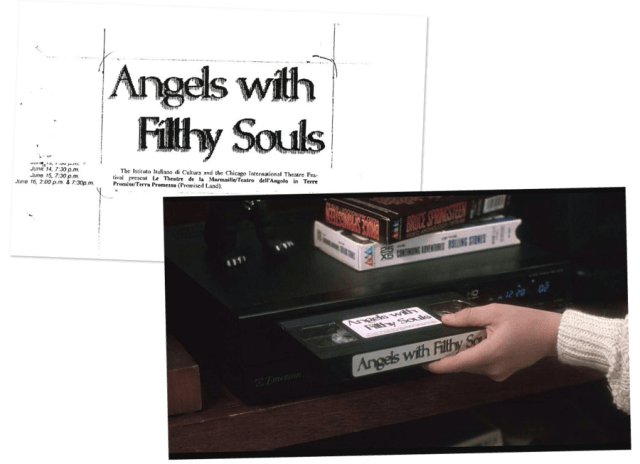
There’s one other movie that’s featured in the film: Angels with Filthy Souls. Kevin finds a VHS tape of it and, presumably titillated by the title, slips it into the VCR. (It sure beats the the other choices on top of the player, the boomer rock of Bruce Springsteen and the Rolling Stones.)
home-alone-filthy-animal-scene-01

He and the audience see what appears to be a 1930s film noir, in black and white of course. A trench-coated guy named Snakes, who has a very gangster look to him, pays a call on a private eye named Johnny. (Even if we couldn’t backwards-read the words “Private Investigator” on his  frosted-glass door, we could tell his occupation by the frosted-glass door itself.) There’s something odd about the clip, however. For one thing, Johnny has a really strong Chicago accent, not something often heard in movies; just listen to the way he says, “He’s upstairs, taking a bey-uth.” For another, Angels with Filthy Souls sounds just a little too over-the-top to be the title of a sequel to the real ’30s movie Angels with Dirty Faces. And finally, the shoot-him-full-of-lead sadistic violence, followed by the gleeful catchphrase-to-be, “Keep the change, ya filthy animal,” would in no way have passed muster with the Hollywood Hays office at the time.

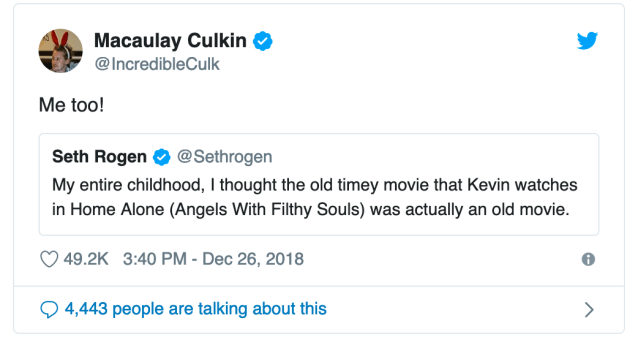
Nevertheless, some people persisted for a long time in believing Angels with Dirty Souls was a real movie–including Seth Rogen, Chris Evans, and Nick Kroll.

Screen Shot 2019-03-07 at 2.55.40 PM

And also including Macaulay Culkin!

Screen Shot 2019-03-07 at 2.57.50 PM

I’m not sure what disabused Rogen of his error, but he would have known the truth had he read a 2015 Vanity Fair article that told the whole story of the conception and production of Angels, down to the care taken to recreate the noir look. Director of Photography Julio Macat

persuaded Columbus to shoot the sequence using the techniques and black-and-white negative film stock of movies from the 40s. The high-key lighting, high-contrast aesthetic would evoke “a cross between film noir and the really crazy stuff you see in early television, like Playhouse 90 or One Step Beyond,” said production designer John Muto.

Like most of the other interior shots in Home Alone, including all the scenes inside the McCallister family home, the sequence was shot on a sound stage in the abandoned New Trier West High School gymnasium. The entire set consisted of just a couple of walls. (Webster suspects that the walls were reused in the “real world” of the movie, for the set of the police office. “We didn’t have the biggest construction budget.”)

Johnny’s office was designed especially for maximum dramatic backlighting potential: pebbly-textured translucent glass on the door and a Palladian window that would sinisterly spotlight him at his desk through Venetian blinds.

As I suggested earlier, Home Alone is a well-oiled machine, and of course, true to the principle of Chekhov’s gun, Angels with Dirty Souls shows up again, and again, used by Kevin as part of his whole-house booby trap strategy. The second time, he’s trying to foil the inept crook Marv (Daniel Stern).

Hughes and Columbus were not done with Angels with Filthy Souls. Its sequel — Angels with Even Filthier Souls — shows up in their 1992 sequel, Home Alone 2: Lost in New York, and repetitively is used to scare the officious concierge at the Plaza Hotel (Tim Curry).

Merry Christmas, ya filthy animals.

‘It’s a Wonderful Life’ in ‘Home Alone,’ ‘Bruce Almighty,’ and, well, practically everything.

my_so_called_life
A mashup of this movie and TV series would be called “My So-Called Wonderful Life.”

A couple of posts ago, I suggested that Brief Encounter may hold the record for being used in the most other movies. Ben Zimmer, whom I sometimes think of as my own personal fact-checker, begged to differ. He nominated Frank Capra’s It’s a Wonderful Life (1946) as the record-holder, and while I’m not positive, I’m pretty sure Ben is right. The Films in Films blog lists fourteen separate movies containing IAWL clips, starting with Music of the Heart; Bruce Almighty; Gremlins; Android; The Big Picture; National Lampoon’s Christmas Vacation; Money Train; Look Who’s Talking; The Ref; Meet Dave; Menace II Society; Trauma; and Nuovo Cinema Paradiso. In Home Alone, the movie is dubbed into French.

The sequel, Home Alone 2: Lost in New York, in a callback, has a Spanish version of IAWL.

The IMDB “Connections” feature, unbelievably, lists fifteen more films in which It’s a Wonderful Life is shown, including Doc Hollywood, Deadly Obsession, and Same Kind of Different For Me. IMDB also says the Capra film is watched by characters in at least twenty television series, including My So-Called Life, Roseanne, Muppet Babies, Cheers, and, of course, The Sopranos.

Every single one of those movies and episodes was made after 1974, and ten of the fourteen movies on the Films in Films list came out between 1974 and 1993. Those dates are significant because during that twenty-year period, through a quirk in copyright law, It’s a Wonderful Life was in the public domain. As a result it aired repeatedly on TV during the Christmas season and came to be seen as the quintessential Christmas movie.

Thus a well-chosen and well-placed clip from the movie can make a potent counterpoint to the doings in any holiday-set film. And best of all, in the twenty-year public domain period, you didn’t have to pay for the rights! As Louisa Mellor wrote on Den of Geek!:

If [a TV] episode needs to quickly establish that it’s Christmas Eve, it’s as easy as inserting a few seconds of Clarence and George into a scene. If a film wants to evoke cynicism around the festive period, then its characters need simply complain, Al Bundy-style, that there’s never anything else on TV. When creatives want to piggyback on some ready-made sentiment or create unlikely juxtapositions then, copyright permitting, Jimmy Stewart and Donna Reed are their guys.

Tom Shadyac directed Bruce Almighty in 2003, at which point It’s a Wonderful Life was no longer in the public domain, but Spyglass Entertainment and Universal Pictures evidently thought they could afford the licensing fee. The film is used not for cynicism, sentiment, or juxtaposition, but for some clever mirroring, similar to the way The Quiet Man is used in E.T. the Extraterrestrial. Despite temporarily becoming God, Bruce (Jim Carrey) is having romantic troubles with his girlfriend (Jennifer Aniston), not so subtly named Grace. He’s at a party, and wants her to come, but she won’t pick up the phone when she calls. So he does a bit of divine intervention and makes a certain movie come on her TV. Jimmy Stewart’s line “I’ll give you the moon, Mary” is a reference to an earlier romantic moment in Bruce, and is guaranteed to do the trick.


‘Maresi’ (?) in ‘The Third Man’

In writing the previous post, on the use of Brief Encounter in numerous films, I learned that the British Film Institute once chose The Third Man (1949) as the greatest British film of all time. I was therefore happy to have a chance to see Carol Reed’s noir classic recently, on the big screen of the Prytania Theatre in New Orleans, in magnificent black and white.

And what do you know, there is a movie-in-movie scene. Holly Martins (Joseph Cotton), an American just arrived in post-war Vienna, finds himself investigating some shady doings. In this scene, accompanied by actress Anna Schmidt (Allida Valli), he is about to question the porter of an apartment building. However, it turns out that the porter is dead, and his little son points to Holly as being the killer. There ensues an almost comically low-speed chase, accompanied by the movie’s defining zither music, with the little kid somehow being the fastest pursuer.

Holly and Anna duck in to a movie theater, which inspired me to add a new tag to the blog: “On the run.”


As you’ve observed, we don’t see the movie, only hear it. That makes it hard to identify, even more so when (like me) you don’t understand German. A clue is the title on the marquee of the theater:

MovieTheater1_Porzellangasse19

IMDB reveals that Maresi was indeed an Austrian film, released in 1948, and starring Maria Schell. The indefatigable Ben Zimmer has unearthed a plot summary (translated from the German by Google Translate): “An aging nobleman shoots his favorite horse, Maresi, who has sunk to the cab of a hawk, to spare him a dignified age – at least to him.”

Of course, movie continuity follows its own rules: the interior scenes might have been shot in a different theater or a sound stage, and the audio might have been from a different film.

So I appeal to speakers of German and/or scholars of Austrian film? What can you tell me about the movie that’s playing while Holly and Anna plot their next move?

Update: Hari List, who runs Bruttofilmlandsprodukt.net, a blog and podcast dedicated to Austrian film and TV, responded to my request for information on Twitter, where his handle is @HariLi. He reported that he was unable to find out anything about the soundtrack we hear when Holly and Anna are in the cinema.

It sounds “old”, as in bad speakers or gramophone. The dialogue is pretty basic, borderline nonsensical. It could be from an old movie that has been badly dubbed, but the dialogue stops when Holly and Anna talk and then resumes. Has to be a nondiegetic track, probably recorded just for that, which makes sense from the filmmakers standpoint. [“Diegetic music in a film or TV programme is part of the action and can be heard by the characters.”–Cambridge English Dictionary.] Also the audience smirks don’t fit, because nothing funny or in anyway emotional was said.  Lastly, the movies listed out front: Irrtum im Jenseits is Michael Powell’s A Matter of Life and Death, Feuervogel is part one of the two-part cinema cut of the western series Miracle Rider (1936) with — as  seen — Tom Mix. On top it probably says Glück muß man haben (You have to be lucky) …which is a German film from 1945, that premiered 1950 – so again some timeline issues but it says “our next movies”, so it’s an announcement. Vier Humoresken was probably an individual comedy shorts program. Btw the cinema still exists, but is a stage theater now.”


‘The Bicycle Thief’ and ‘Habeus Corpus’ in ‘The Player’

I would not have expected Robert Altman to have much of a presence on this blog. I feel that he preferred being in control of all the irony, rather than appropriating it from an interpolated film made by some other hand. And sure enough, only two of his many movies appear on the comprehensive Films in Films website. The first is Short Cuts (1993), in which Monster in the Closet (1986) plays on a television. (Part of the reason Altman chose that slasher flick may be that three members of his unofficial stock company — Henry Gibson, Paul Dooley, and Howard Duff — are in it.)

The second is The Player (1992). And sure enough, the main movie-in-movie scene comes from its source material, the 1988 novel of the same name by Michael Tolkin, who adapted it for the screenplay. In novel and film, the title character, master-of-the-universe movie executive Griffin Mill (Tim Robbins), has been receiving threatening post cards from an anonymous angry screenwriter. He thinks he’s figured out that the correspondent is David Kahane (Vincent D’Onofrio) and phones him; his girlfriend answers and says that Kahane is at the movies — specifically, the Rialto in Pasadena, watching Vittorio De Sica’s 1948 The Bicycle Thief. (The title literally translates as “Bicycle Thieves,” but it’s commonly known by the singular in the U.S.)

In the novel, Mill slips into the theater for the last twenty minutes of the movie. Tolkin tells us his reactions, which are film-savvy, naturally, but as off as you would expect from a ’90s Hollywood exec giving notes on Italian neo-realism:

Griffin watched a father and son search for the lost bicycle. Knowing the title, it was obvious that someone had stolen the bike, that this poor man needed it, and that he and his son were now, since the movie was almost over, close to finding the bike and the person who had stolen it. It’s a good title, thought Griffin. He liked a movie where the story and the title were the same thing.

He doesn’t like the ending; it’s “so unnecessarily sad.” He wonders: “Was there a sequel?”

Altman has some nice tweaks on the scene. Griffin’s in the theater less than a minute and never once is shown watching the movie; he keeps furtively looking around for Kahane. The Bicycle Thief is so far away from his world as not to exist at all.

When the lights comes on, Griffin spots the screenwriter, and, true to form, tries to bullshit him: “Great movie, huh? So refreshing to see something like this after all these… cop movies and, you know, things we do. Maybe we’ll do a remake of this!”

The sequence is only a small part of The Player‘s all-encompassing commentary on the movies, which manifests itself in varying levels of explicitness. In the very first scene, Griffin and others at this studio talk about the six and half minute tracking shot that opens Orson Welles’s Touch of Evil — and it’s all part of a eight minute and fifteen second tracking shot that opens The Player. Later, we see the shooting of a noirish feature with Scott Glenn and Lily Tomlin, Lonely Room, that’s a counterpoint to the crime story Grifffin finds himself a part of.

A post at Films in Films notes that we see dozens of classic film posters in The Player, many of which offer commentary on the action playing out in front of them.

MV5BMTkxNjk2MTg5NF5BMl5BanBnXkFtZTcwNTc3NTU0NA@@._V1_SX1472_CR0,0,1472,999_AL_
Griffin Mill (Tim Robbins) below portentous posters.

For me, the reflexive aspect of the film that packed the biggest emotional punch was the array of actors playing themselves, especially the ones that have died in the meantime: Steve Allen, Jayne Meadows, Jack Lemmon, Burt Reynolds, Rod Steiger, Patrick Swayze.  It was like spending some good time with ghosts.

The main movie-within-a-movie in The Player is a project called Habeas Corpus. It’s pitched to Griffin early on — a message movie about capitol punishment, with no stars, and a downbeat ending where the main character dies. Needless to say, he passes, for it lacks just about every element (as he says in a different scene) that make up successful movies: “Suspense, laughter, violence. Hope, heart, nudity, sex. Happy endings. Mainly happy endings.”

For spoiler-related reasons I won’t go into, Habeas Corpus does end up getting made, and at the end of The Player, we see execs screening the ending. Lots of cameos here: Susan Sarandon, Louise Fletcher, Peter Falk, Ray Walston, Jack Riley (Mr. Carlin from The Bob Newhart Show), and Altman stalwarts Bert Remsen, Paul Dooley, and Rene Auberjonois are all in the sequence. At the end of a(nother) long tracking shot, the death-row prisoner turns out to be Julia Roberts, showing some leg. She was the very sort of star the screenwriters had vowed would not be in the movie. Her presence is just the first of a host of broken promises, and it kicks off a Hollywood Ending that provides the Hollywood ending to The Player.


‘Garden Tool Massacre’ in ‘The Blob’ (1988)

Garden-Tool-Massacre

With this second post on a film about a gelatinous terror, Movies in Other Movies might start to get known as “The Blob Blog.” (Apologies to “The Bob Loblaw Law Blog” on Arrested Development.) Anyway, when director Chuck Russell and his co-writer, Frank (Shawhank Redemption) Darabont, set about remaking the cult horror classic The Blob, they must have had fun figuring out what movie to have running in their version of the climactic blob-goes-wild-in-movie-theater scene.

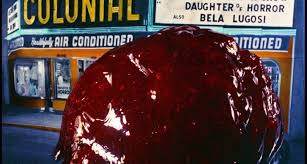
In the original, Irvin Yeaworth used the weird and obscure Daughter of Horror. Russell and Darabont, in keeping with their tongue-partly-in-cheek approach, opted to concoct their own, a Halloween/Texas Chainsaw Masssacre pastiche called Garden Tool Massacre. Announcing his plans to see it, youngster Eddie Beckner tells his friend’s mom “It’s your basic slice and dice.”

Mrs. Penny: Your basic what?

Eddie: Well this guy in a hockey mask, he chops up a few teenagers, but don’t worry, there’s no sex or anything bad.

From what we see of the picture, he’s a pretty good film critic. He probably didn’t anticipate that the sound-syncing would be horrible (another sly touch by Russell).


“Wait a minute … hockey season ended months ago”: a great line.

The slob in the Hilti hat (another sly power-tools reference) thinks he knows movies, too, but he doesn’t know enough to keep his mouth shut. And nobody in the audience knew enough to realize they never, ever, should have set foot in that theater.

‘Stagecoach,’ ‘Angel and the Badman,’ and ‘Fort Apache’ in ‘The Apartment’

Billy Wilder’s The Apartment (1960) marks the director’s third appearance in this blog, for the moment passing Alfred Hitchcock (Sabotoge and Saboteur) in the top spot. (Wilder’s previous two entries were Sunset Boulevard and Witness for the Prosecution.)

Apartment_60The Apartment, which won Oscars for Best Picture, Best Director, and Best Original Screenplay (by Wilder and I.A.L. Diamond), was presented as a comedy that mocked romantic mores and man-in-the-gray-flannel-suit corporate culture, with its notorious attachment to the suffix “-wise.” But removed from its turn-of-the-decade context, and especially viewed in the light of the Me-Too movement, the film is chilling.
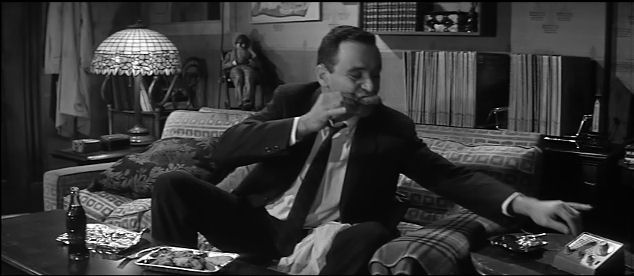
C.C. Baxter (Jack Lemmon), a peon in mammoth Consolidated Life Corp., has pimped out his Upper West Side apartment: he lets a quintet of executives use it for their trysts with secretaries and other female prey, in exchange for vague promises of corporate advancement. His neighbors, hearing the all-hours mayhem but unaware of the arrangement, think he’s a wild and crazy guy! Pretty funny! (Adding to the comic feel, inadvertently, is the fact that the five execs would go on to become staples of 1960s sitcoms: Fred MacMurray in My Three Sons, Ray Walston as My Favorite Martian, David White in Bewitched, and Willard Waterman on Dennis the Menace. David Lewis, meanwhile, played Warden Crichton on Batman, Senator Ames on The Farmer’s Daughter, and three separate roles on The Adventures of Ozzie and Harriet.)

The movie-in-movie scene comes early. The Lewis character has stayed on past the agreed-upon-time, forcing Baxter to roam the chilly New York streets, his body hunched in the classic Jack Lemmon slouch, his tan cotton raincoat turned up around his neck. When he can finally return, he heats up a TV dinner, brings it to the couch, and turns on the TV using a remote control, unusual at the time.

remote

BTW, I got the above image from an online discussion about the remote control in The Apartment, which suggests that any topic, no matter how obscure — or maybe the more obscure, the better — has its own online forum.

When the TV comes on, it shows an unctuous host announcing an imminent showing of the 1932 melodrama Grand Hotel, which Baxter seems to be happy about, maybe because its high-gloss world promises a complete escape from his own sordid one. But then the host presents a word from “our sponsor” and Baxter starts clicking. He successively lands on three different channels showing three different movies. (That is an anachronism. I lived in the New York television market in 1960 and can attest that it wouldn’t have happen that four channels would have movies on at the same time.)

Those three films are all John Wayne oaters: Stagecoach (1939), Angel and the Badman (1947), and Fort Apache (1948). The first and third were directed by John Ford, and I imagine Wilder, a German refugee who never made a Western, had in mind a subtle homage to that great Hollywood movie maker, different from him in just about every way.  The scenes that come on Baxter’s screen are all gunfights and bar fights and galloping cavalry, however, which are too much for his nerves at the moment. So he clicks back to Grand Hotel, hopefully. What he encounters actually is funny.


‘Jesse James’ in ‘Witness for the Prosecution’

witness-7-620x376
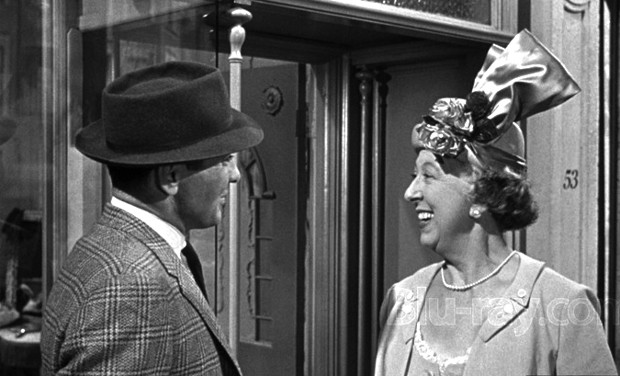
Leonard Vole (Tyrone Power), Mrs. French (Norma Varden), and their hats.

We last encountered Billy Wilder in Sunset Boulevard. He was having Gloria Swanson, as Norma Desmond, watch one of Norma’s old silent films, only it was one of Gloria’s — Queen Kelly.

Wilder pulls a similar trick in his 1957 courtroom thriller, Witness for the Prosecution, in which Tyrone Power plays Leonard Vole, a World War II veteran in London who has landed in a spot of trouble. We learn in flashbacks that he’s invented a newfangled egg-beater and has been trying to peddle it, without much luck. That is, until he and Mrs. French (Norma Varden), a wealthy widow, meet cute in a shop where she’s buying a smart new hat, and he commences a flirtation with her. I didn’t mention that Leonard is married; his wife, Christine, is played by Marlene Dietrich.

I pause here to say that one of the more mysterious things about Witness for the Prosecution is Vole’s nationality. A commenter on IMDB says that William Holden was Wilder’s first choice for the part, and that Gene Kelly, Kirk Douglas, Glenn Ford, and Jack Lemmon were considered before Power, also an American, accepted. He makes no effort to do an English accent, and at least one book on Wilder takes Vole to be an American. Yet the script — by Wilder, Harry Kurnitz, and Larry Marcus, based on Agatha Christie’s play — makes no mention of his not being British, and even gives him some Britishisms to say.

Three of these appear in the movie-in-movie scene. Discouraged by a lack of eggbeater interest, Vole repairs to a cinema. Who should sit in the row in front of him but Mrs. French, her hat obscuring his view of the shoot-em-up Western on the screen? He invites her to sit next to her, and explains, “That chap on the white horse is called Jesse James. Those others have led him ambush. It’s not at all cricket.”

The film they’re watching was made in 1939 and is called Jesse James. The title character (not discernible in the Witness for the Prosecution scene) was played by Tyrone Power.


‘Rebel Without a Cause’ in ‘La La Land’

la

No one can say they don’t make movies-in-other movies anymore. The current Blackkklansman (post to come) puts a not especially flattering spotlight on two old films. La La Land (2016), which famously won, then didn’t win, the 2016 Best Picture Oscar, features just one, but it’s in a pivotal scene.

In this musical, aspiring jazz musician Sebastian (Ryan Gosling) and aspiring actress Mia (Emma Stone) don’t-meet cute a couple of times, then manage to connect and have some conversations that suggest they are kindred spirits. Sebastian is movie-besotted. He  quotes some lines from Rebel Without a Cause, and when he realizes she’s never seen it, he invites her to meet him at the Rialto, where it’s playing, later that week.

Because of plot complications, she arrives at the Rialto — and by the way, both exteriors and interiors were filmed at the real Rialto Theatre, in Pasadena — after the movie has already started. She stands in the front, looking for Sebastian, and he sees her with appropriately cinematic illumination.

They settle in to watch the movie, as the famous Griffith Park scene is about to begin, but just as things are about to heat up between them, something burns up and spoils the mood.

At that point, Mia suggests they take a drive to the real Griffith Park, which they do, director Damien Chazelle’s camera recreating the scene from the original. They break in to the Observatory through in open door and share a celestial dance. It’s a nice movie-loving scene, in a nice movie-loving movie, and if you haven’t seen it I heartily recommend you rent it, or stream it, or, on the off-chance it’s playing at the Rialto, go see it as films were meant to be seen.

‘Daughter of Horror’ (‘Dementia’) in ‘The Blob’ (1958)

blob

Among the many strange things about Irvin Yeaworth’s The Blob (1958) is the notion that the Colonial Theater in Phoenixville, Pennsylvania, could fill nearly all its seats with a midnight showing of the extremely obscure Dementia, a 58-minute dialogue-less reverie of a woman’s nightmare. When that film opened in 1955, Variety said it was “Maybe the strangest film ever offered for theatrical release.” It was recut and retitled, as Daughter of Horror, and a voice-over narration by future Tonight show sidekick Ed McMahon was added, but it didn’t do any better at the box office.

Anyway, another odd thing is that Yeaworth lights the audience at the Colonial (which is still in operation, barely forty miles from where I’m writing this) about as brightly as if they were taking a walk under the noonday sun. And another: when we initially see them, they watching creepy sights and listening to Ed McMahon say, “Now all the images of horror, the demons of your mind, crowd in on you to destroy you.” But they are looking at Daughter of Horror as impassively as if it were a Chevy commercial. This film demands a response! The second reaction shot at least shows them starting to titter, and by the third, they’re laughing uproariously. Unfortunately, by this time, bad things are happening to the Colonial’s projectionist, who is also sunnily lit and who has left himself vulnerable to blobby mischief by burying his nose in a book.

I can laugh all I want at The Blob, but (according to Wikipedia) it had a budget of $110,000 and earned $4 million at the box office, for a return on investment of more than 3500 percent.  Mental Floss’s list of the twenty most profitable movies of all time is topped by Paranormal Activity (2007), with a ROI of 19,749 percent and The Devil Inside (2012) at 3632 percent. The Blob should be number 3 but is absent from the list. Which goes to show, blobs don’t get no respect.


‘An Affair to Remember’ in ‘Sleepless in Seattle’

3-rosie-and-meg-sleepless
Rosie O’Donell and Meg Ryan bonding over “An Affair to Remember”

All movies are about movies, but Nora Ephron’s Sleepless in Seattle (1993) is about movies more than most. The characters habitually measure their own lives against what they’ve seen onscreen. Sam (Tom Hanks), a recently widowed architect, thinks about inviting a potential date over to look at swatches, but then muses that Cary Grant wouldn’t be caught dead looking at swatches with a woman. His ten-year-old son, Jonah, asks whether Sam will have sex with the swatch-woman; Sam, in a rookie move, says yes. Jonah tells him to be careful: “In movies, women are always scratching up the man’s back and screaming.”

All told, the words “movie” or “movies” appear fifteen times in Ephron’s screenplay.

The most movie-obsessed character, by far, is Annie (Meg Ryan), whom we see in an early scene watching An Affair To Remember (1957), starring the aforementioned Grant, on TV with her best friend, Becky (Rosie O’Donnell). After some portentous dialogue between the impossibly handsome and tanned Grant and Deborah Kerr, Annie laments, “Those were the days when people knew how to be in love…. It was right. It was real. It was …”

Becky breaks in: “… a movie. That’s your problem. You don’t want to be in love. You want to be in love in a movie.”

In a clever conceit, all females in this film are obsessed with An Affair to Remember, including an Empire State Building Security guard’s wife and Sam’s sister, Suzy (Rita Wilson), who can’t even summarize the plot without breaking into tears. Her husband, Greg (Victor Garber) teams up with Sam for a very funny response.

(In a piece of dialogue that apparently was cut from the shooting script, a detective Annie has hired to stalk Sam says she reminds him of “Glenn Close in that movie,” i.e., Fatal Attraction.)

Ephron has movies on her mind too: Sleepless is a love letter not so much to the ’50s women’s picture weepy An Affair to Remember as to the classic screwball comedies of the ’30s and early ’40s, the best of which, like Bringing Up Baby and His Girl Friday, featured Grant. Bill Pullman plays the Ralph Bellamy role–the well-meaning but terminally dull fiancee Walter. Ryan’s a reporter, like Rosalind Russell in Friday and Barbara Stanwyck in Meet John Doe. And Hanks and Ryan are the impossibly good-looking (though not tanned) leads, whose love has a supernatural sway over the actions and intentions of mere mortals. Just like in the movies.

(The clip below starts with the movie-on-movie scene, which ends at about the 2:30 mark. Because of technical difficulties, I was unable to trim the rest of the clip. It doesn’t have any movie-watching stuff, but it’s pretty good. In fact, I recommend watching the whole movie if you haven’t seen it recently. As of last week it was streaming for free on Verizon Fios On Demand.)