‘Happy Endings’ in ‘New York, New York’ (and ‘Spaceballs’ x∞)

The recent post on Scream 4 brought up the question, are there any other cases of a movie in a movie in a movie? Ben Zimmer was quick to bring up Mel Brooks’s Spaceballs (1987) in which Dark Helmet (Rick Moranis) and other characters watch themselves watching themselves watching themselves… (In a less endlessly recursive way, Blazing Saddles was shown in Brooks’s Blazing Saddles.)


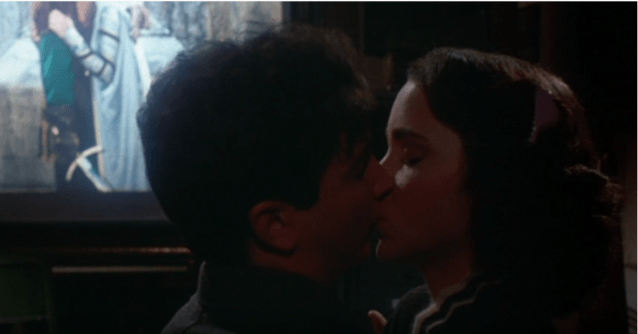
I’d say it merits an asterisk, as does the only other movie-in-movie-in-movie example I’ve found, New York, New York (1977). Actually, I’d give Martin Scorsese’s film two asterisks. The first is because this twelve-minute sequence was cut out of the original theatrical release, only to be restored in 1981. The second … well, I’ll explain. In the movie, set in the 1940s, Liza Minelli plays singer/actress Francine Evans, who, after breaking with saxophonist Jimmy Doyle (Robert DeNiro), whose middle name should be “Nogood,” hits it big, including landing the starring role in a movie musical called Happy Endings.

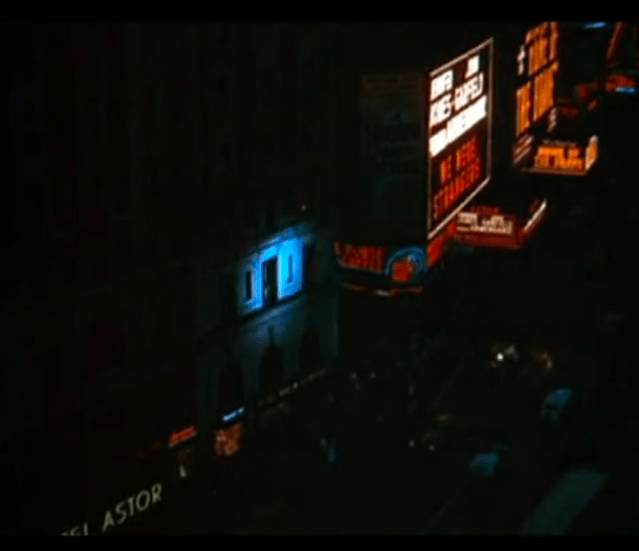
In Mean Streets and Taxi Driver we learned Scorsese is fond of Times Square marquees, but he takes it to a new level here. At the start of the sequence is an establishing shot.

Screen Shot 2020-05-20 at 10.24.12 AM

We know it’s Times Square because of the Hotel Astor (lower left), which was on Broaadway between 44th and 45th Streets. And we know it’s 1949 because that’s the year of the two other (carefully selected) films on the marquees, John Huston’s We Were Strangers and Mark Robson’s Home of the Brave. Happy Endings, meanwhile, is opening at  the “New York Music Hall” — a riff on Radio City Music Hall, actually half a mile to the northeast.

Screen Shot 2020-05-20 at 10.16.51 AM

We go into the theater only to see a Happy Endings scene set in a movie theater. Francine plays “usherette” Peggy Smith; in the the stylized set (production design by Boris Leven), still more movie marquees (including the Apollo, a Scorsese favorite) are seen behind the audience. Also behind them is a beam of light from a projector — it contains, tantalizingly, the movie within the movie within the movie, which we can’t quite see.


Peggy meets Donald (Larry Kert) who turns out to be a movie producer and makes her a star. There are a series of production numbers, and we see superimposed titles and marquees (more marquees!) of her starring roles: Princess Sargeant, The Girl from Rio (actually the title of a 1969 spy movie), The Long Waltz (possibly a nod to Scorsese’s own The Last Waltz, and inadvertently misspelled in the marquee).

Screen Shot 2020-05-20 at 10.45.53 AM

In a Star Is Born–like arc she loses Donald when she eclipses him, but (happy ending) gets him back … but wait, it was all a dream, and she’s back as an usherette. But wait! She meets Donald again — and all of a sudden, Peggy jumps into the movie screen, a la Buster Keaton. So there’s your movie in a movie in a movie. With asterisk.


And if anyone’s interested in seeing the whole twelve-minute sequence, here you go:


‘Darkness at Noon’ and ‘Talking at Noon’ in ‘The Good Wife’

Picking up on the thread of TV series with continuing fake TV series, YouTube user Charlie has helpfully put together this montage of scenes from two fake shows — Darkness at Noon and Talking at Noon — that periodically showed up in the CBS drama The Good Wife (2009-2016).

Some good stuff there, as when Alicia Florrick (Julianna Margulies) glances at the screen and asks her daughter, “What’s going on?” The response: “He shot the bald guy, now they’re blaming the other guy, now she’s in trouble.” Pretty elegant recap.

Or the troubled hero’s soliloquy: “People just think there are black hats and white hats, but there are black hats with white linings, and white hats with black linings, and there are hats that change back and forth between white and black, and there are striped hats. Evil rests in the soul of all men… and there is nothing you can do but curse God.”

Another nice touch is the spoiler-dispensing Talking at Noon, the chat show about the show within the show. It’s takeoff on AMC’s Talking Dead, which debuted in 2011 to hash and rehash that network’s The Walking Dead, thus inventing the now-thriving genre of “aftershow.”

According to an IndieWire article, Darkness at Noon began as a shot at another AMC show, Low Winter Sun (which had been cancelled after one season by the time Darkness at Noon appeared, which seems a bit punching down) and “evolved into an ongoing satire of TV-antihero tropes.” To me, the dopey dark existentialism evoked another cable cop show HBO’s True Detective.

In fact, every platform has its pluses and minuses, specifically when it comes to shows about crime, criminals, and the law. The premium cable of HBO and its brethren, with its primo production values and near-total freedom in terms of sex, violence, and language, sometimes seems to rely on, or revel in, those things at the expense of character and plot, and invoke a cheap nihilism. Basic cable — like AMC and FX — to me often hits a sweet spot, in shows like Fargo and Better Call Saul, but even they tend to operate with a surfeit of testosterone (note the Everest-like left breast of the Darkness at Noon corpse) and be overly concerned with who is the biggest “badass” (a favorite approbative word on Talking Noon).

The shortcomings of broadcast TV are pretty well known. Most of them relate to various sorts of unrealisticness. The Good Wife, which was the brainchild of show-runners Robert and Michelle King, was definitely better than most. I watched it for the last two-thirds of its run and enjoyed, among other things, its unusual savviness about politics and the law, the better-than-average use of “ripped from the headlines” plots, and great characters portrayed by Alan Cumming, Christine Baranski, Sarah Steele, and Stockard Channing, among others That list, along with the (not as strong IMHO) title character, suggests the good job it did reversing TV’s traditional gender imbalance.

But the show also had its share, and at times more than its share, of soapy melodrama. To get a small sense of that, here’s Wikipedia’s summary of one of the not-so-great characters:

Blake Calamar (Scott Porter) is a private investigator for the firm who competes with Kalinda. He tries to frame Kalinda for putting a doctor in a coma but fails. He finds out that her former name was Leela Tahiri and Peter helped her change it. In return, she slept with Peter.

When stuff like that happens, as someone once said, there is nothing you can do but curse God.


‘The Terrance and Phillip Show’ in ‘South Park’

terrance-and-phillip-south-park-vector-800x566
Terrance and Phillip

I believe I’ve only covered one instance of a fake TV shows in a real one, The Itchy & Scratchy Show in The Simpsons. But it’s a pretty pervasive phenomenon, as I learned from an Entertainment Weekly article by Chancellor Agard and Ernest Macias. They list the ten best uses of the trope (I think they go in reverse order of best-ness):

  • Chicago Penthouse (spoof of reality shows) in The Good Fight.
  • The Valley (Southern California soap) in (Southern California soap) The O.C.
  • Inspector Spacetime (Dr. Who parody) in Community.
  • El Amor Prohibido (telenovella) in Arrested Development.
  • Terrance and Philip in South Park.
  • Due North (Underground spoof) in Insecure.
  • Defamation (Scandal spoof) in Dear White People.
  • MILF Island in 30 Rock. 
  • Invitation to Love (daytime soap) in Twin Peaks.
  • Darkness at Noon in The Good Wife.

As the list makes clear, this is generally a satire of either specific or generic TV content. (Fake-movies-in-movies are a similar deal.) The spoofs range from blunt to sharp, as spoofs tend to do.  (I cracked up at the tagline for MILF Island, a summer reality show: “Twenty-five super-hot moms. Fifty eighth-grade boys. No rules.”) But the more interesting cases are where the fake shows combine satire with a meta-commentary on the “real” program. That’s definitely the case with Itchy & Scratchy, with Invitation to Love, on Twin Peaks, which I plan to cover in a future post, and I imagine (haven’t seen it yet) with The Valley.

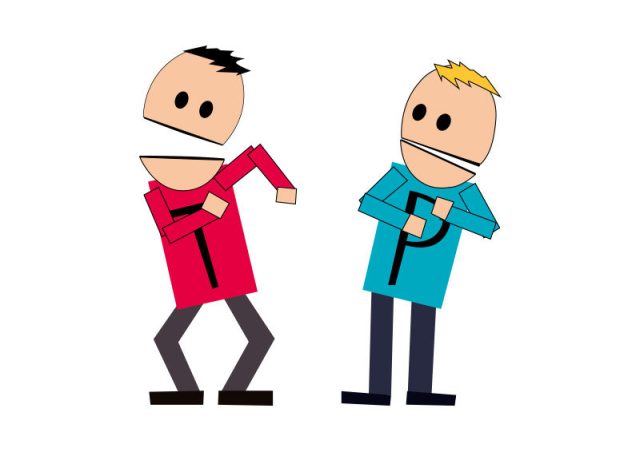
And with Terrance and Phillip, which basically takes all the criticisms of South Park, sees them, and raises them two. Is the animation crude? T and P is even cruder, with characters’ heads that are horizontally cut in half and bob up and down to portray talking. And is the humor crude? Again, even cruder, consisting almost entirely of fart jokes and bad ethnic insults. Here’s a South Park fan site on the characters’ origin story:

The two characters have heavy accents, ostensibly to represent stereotypical American views of Canadians. The “aboot” pronunciation has also been used in The Simpsons and Canadian Bacon. The fact their career is based on an accidental fart Terrance made on the The Ed Sullivan Show at the age of six, because that was the only part of their act Americans understood, may be saying something about Canadian perceptions of Americans.

The duo popularized a catchphrase in the show-within-a-show, as they would invariably say “You FAH-ted!” and then giggle to almost any farting sound.

And here’s a clip from a recent episode. Terrance and Phillip are the ages they would be in 2017, given the Ed Sullivan appearance (an implicit commentary on the convention of animation characters never getting older).  They’ve got a new show, on Netflix, but their humor is the same old thing.

Next: Darkness at Noon (and Talking at Noon) on The Good Wife.

‘Stab 6’ and ‘Stab 7’ in ‘Scream 4’

Among the many gaps in my knowledge, one of the gappiest involves slasher/horror films. Like, I’m aware they exist, that some smart people like some of them, and that Wes Craven is a personage, but after that I’m pretty much done. So when a Google search led me to the opening scene of Craven’s Scream 4, (2011) it was all new to me.

Take a look.


Having seen the clip, you might be able to guess what my Google search was: “movie in a movie in a movie.” A few other contenders pop up, but this was the best, as we open with (what turns out to be) a scene from (the fictional) Stab 6, which has been watched by characters (played by Anna Paquin and Kristin Bell) from Stab 7, which has been watched by characters (Aimee Teegarden and Britt Robertson) from the “real” Scream 4.

That Russian-doll setup suggests the very self-aware quality of the whole Scream series (I have learned), in which the eerily similar Stab series serves as a sort of running self-conscious commentary. How can you not like a slasher movie where a slasher-movie-slasher-movie-in-movie character (Paquin), scoffs, “A bunch of articulate teens sit around and deconstruct horror movies until Ghostface kills them one by one. It’s been done to death. The whole self-aware, meta shit. Stick a fork in it.” Right before she gets stabbed in the throat by Kristin Bell, who must have loved playing against nice-girl type.

And speaking of self-aware, meta shit, the Scream films have a generous supply of strategically chosen actual movies in them. According to IMDB Scream‘s got Frankenstein, Halloween, Prom Night, and The Thing from Another World; Sceam 2, Nosferatu; and Scream 4, Shaun of the Dead. (Returning the favor, Halloween H20 has a scene from Scream 2.)

I’ve got another movie within a movie within a movie in mind, but I’m curious to see if anyone has some suggestions of their own.

What’s the Worst Fake Bad Movie?

Careful readers of this blog know that there’s a category on it called “Not Real,” covering cases where the movie or TV show the characters are watching isn’t, you got it, real. You can see all such entries by navigating over to the right, scrolling down, pulling down the “Categories” menu, and clicking on “Not Real.”

A disproportionate number of those fake movies are pretty bad, obvious even in the brief glimpse we get of them. Examples would be Flames of Passion in Brief Encounter, Angels with Filthy Souls in Home Alone, Habeus Corpus in The Player, Garden Tool Massacre in the 1988 remake of The Blob, and Coed Frenzy in Blow Out. That badness isn’t really surprising. The director of the real movie is concentrating his or her creative energies on that one; the ersatz film serves to provide some sort of counterpoint, or merely to mock a tired genre. They’re sort of film-school exercises, and I imagine they’re a lot of fun to make.

This post contains a few more examples. At the end, there’s a poll where you can vote for the best worst fake movie of all time. And if you have any other nominees, please feel free to leave them in the comments.

When Christopher Guest’s For Your Consideration came out in 2006, I remember thinking that his “mockumentary” series (Waiting for Guffman, Best in Show, etc.) had pretty much played itself out, and that the only really funny thing was the (bad) movie within the movie, a holiday tearjerker called Home for Purim (Purim being perhaps the most minor of minor Jewish holidays).

I think my take holds up, at least regarding the brilliant excruciatingness of Made for Purim, which is set in the South, probably so as to put on display a dizzying array of bad Southern accents, and set in the ’40s, probably because why would you set a sentimental Purim movie in the ’40s? The clip below is a pretty generous look at it. At the head of  the holiday table is matriarch Esther Pischer (Catherine O’Hara); moving counter-clockwise there’s her son with the guitar (Christopher Moynihan), the Pischer patriarch (Harry Shearer), daughter Callie Pischer, and Callie’s special friend, played by Rachael Harris. (“I did meet a nice fella,” Callie had told Esther in a scenery-munching scene, “… and her name is Mary Pat!“) All are brandishing their traditional Purim noisemakers.

Here are the rest, in chronological order of the real film’s release. Singin’ in the Rain (1952), directed by Gene Kelly and Stanley Donen, is about the difficulties of the transition from silent films to talkies in the 1920s. All of these are on-display in a test screening of The Dueling Cavalier, with Kelly as Don Lockwood and Jean Hagen as absolutely-not-ready-for-sound silent star Lina Lamont. (The rustling of the pearls is an especially nice touch.)

Pretty much every review of Joe Dante’s Matinee (1993) includes the word “loving,” and that’s an apt designation for Dante’s take on the B-movies of the ’50s and early ’60s. Matinee, set in 1962, is about Lawrence Woolsey (John Goodman),  not-so-loosely based on schlock producer William Castle. For showings of his latest production, Mant, Woolsey has rigged up buzzers under the seats in theaters — a nod to what Castle actually had done in 1959 for The Tingler.

This Mant clip is great fun, not only for such lines as, “The ant’s saliva must have gottin into Bill’s bloodstream and gone sraight to his brain,” but also for seeing such Hollywood pros as William Schallert (as the doctor) and Jesse White (as the theater owner). Cathy Moriarty isn’t such a veteran but she’s just right as Mrs. Mant.

Matinee’s counterpoint to Mant is The Shook-Up Shopping Cart, a not-so-loving version of wacky Disney comedies like The Love Bug. (The kids’ bored reaction suggest Dante’s view of the genre.) The clip stars Naomi Watts, just before she got big. And by the way, not to be a stickler, but has any movie theater been as brightly lit as the one in Matinee?

In Frank Oz’s Bowfinger, Steve Martin plays the title character, a wannabe producer who’s as schlocky as Lawrence Woolsey, but way less adept. His accountant has written a script called Chubby Rain, and Bowfinger wants to bring it to the screen, but can do so only if he gets action star Kit Ramsey (Eddie Murphy) for the lead role. Hilarity ensues, which I will spoil only enough to say that Chubby Rain finally gets made, and that it is truly horrible. (Unlike the Dueling Cavalier audience, this one unaccountably goes for it.) In the clip, Martin’s flanked by Jamie Kennedy and Christine Baranski (who’s also in Chubby), and next to Murphy is Heather Graham.

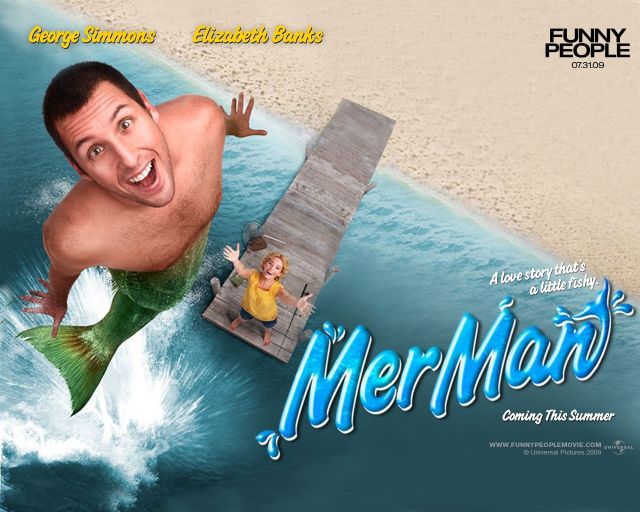
Finally, our shortest clip comes from Judd Apatow’s Funny People. Adam Sandler plays George Simmons, a Sandler-like comedian who has been involved in even dumber properties than Sandler himself. At first we glimpse a poster for one of them, MerMan, with Elizabeth Banks, tagline “A love story that’s a little fishy.”

dd0bfc0b284cae8282e5c08213a99201

Next comes a clip from Re-Do (Justin Long’s the straight man), which takes the premise of Look Who’s Talking and does what you wouldn’t think possible, makes it dumber.

‘The Purple Rose of Cairo’ and ‘Top Hat’ in ‘The Purple Rose of Cairo’

I believe this is the second example in the blog — after Home Aloneof a movie that includes both a real film and a fictional one. And it’s fitting that it follows Buster Keaton’s Sherlock Jr., since that was an obvious inspiration for Woody Allen’s The Purple Rose of Cairo (1985).

One difference is that in Sherlock Jr., the projectionist played by Buster steps into the movie being screened in his theater. Purple Rose of Cairo goes the other way. Set in the Depression, it’s about an unhappy waitress and wife named Cecilia (Mia Farrow) who goes to the movies to escape her woes. She develops a fascination with The Purple Rose of Cairo, a (fictional) RKO madcap melodrama centering on a dashing archeologist named Jeff Baxter (Jeff Daniels). She sits through multiple showings, until something very strange happens (at about the two-minute mark of this clip) …

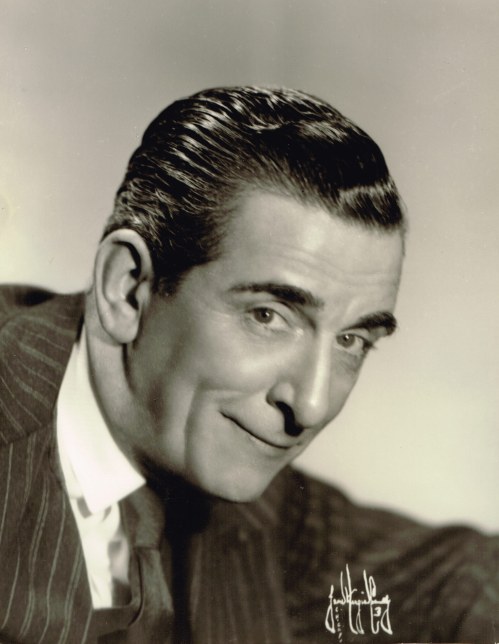
One of the cool things about the sequence is how Allen, famously a movie buff, has captured the look and sound and feel of ’30s films, and chosen actors who fit seamlessly in: John Wood (who could almost be a stand-in for Edward Everett Horton), Edward Herrman, Debra Rush, and Annie Jo Edwards as Delilah, the maid. (The part is a sadly accurate depiction of the sort of roles played by Hattie McDaniel and others, but so distasteful today that I wish Allen had left it out.)

Edward_Everett_Horton
Horton.

Cecilia shows Tom around her New Jersey town, and he — a la Sherlock Jr. — takes her into the film. A cuckoo love triangle ensues involving Cecilia, Tom, and the actor who plays Tom, Gil Shepherd. She chooses Gil (not much future in a romance with a celluloid hero) but gets some bad news as she approaches the theater. (She’s carrying the ukulele because she and Gil have had some great fun dueting.) So she goes in and takes a seat to see the movie that’s just opened, a true-life RKO production, Astaire and Rogers’s Top Hat.

You can see for yourself the effect this transcendent piece of entertainment has on Cecilia. It harks back to the very first film discussed in this blog, Sullivan’s Travels, and in its honor I’ve created a new tag for both movies (and a couple of others): The Transporting Power of Popular Film.


‘Hearts & Pearls’ in ‘Sherlock Jr.’

l3RiIjaN1peXQ2lAwnpF33Xb5R0
Buster in magnifying-glass, false-mustache detective mode.

Hard to believe it’s taken me this long to get around one of the first, probably the greatest, and certainly the most influential movie-in-movie movie. (Woody Allen’s The Purple Rose of Cairo is basically a remake.) I refer to Buster Keaton’s 1924 silent classic Sherlock Jr. Buster plays a projectionist who aspires to become a detective and longs for “The Girl” (Kathryn McGuire. Keaton didn’t give names to any characters in the film, perhaps to emphasize a dream-like quality). Unfortunately, “The Sheik” (Ward Crane) steals the Girl’s father’s watch and pins the crime on Buster, who is banished from the house.

Back at the theater, he’s screening a melodrama called Hearts & Pearls. A sign outside displays its subtitle: “Or, the Lounge Lizard’s Lost Love — In Five Parts.” The title, and the length, are digs at the sentimental work of D.W. Griffith, who had made A String of Pearls in 1918 and who directed at least a dozen movies containing the word “heart,” including The Mother’s Heart, Hearts of the World, True Heart Suzie, Tender Hearts, and A Change of Heart. Buster falls asleep, and a transparent phantasm rises out of his body and looks at the film. As if by magic, the male and female lead (uncredited) suddenly turn into The Sheik and The Girl, and he commences making love to her (in the old-fashioned sense). Buster puts on his hat (of course) and descends from the projection booth to the audience. His reaction to what he sees is probably the greatest example I’ve ever witnessed of someone acting with his back.


Note Buster’s practiced tumble when he’s thrown out of the movie, including breaking his fall with his hands. He had, of course, started his career as a little kid on the vaudeville stage, where his principal role was to be violently tossed about in the family act.

He manages to get back into the movie, and the bulk of (the brisk, 45-minute: no five acts here) Sherlock Jr. shows his increasingly surreal adventures. Just as he’s about to drown, he wakes up in the projection booth. Spoiler alert: it was all a dream. Suddenly, the Girl walks in and announces the truth has been revealed and he is forgiven. In a marvelous closing scene, he looks to the screen for his moves, much as Elliot did, with E.T.’s help. And talk about acting. Keaton hilariously expresses volumes with a shrug of his shoulder or a ten-millimeter eyebrow lift; take one look at his jumpy nervousness and you can see where Woody Allen — an acknowledged fan — got most of his physical shtick.


‘Lord Jim’ and ‘Great Catherine’ in ‘My Favorite Year’

Richard Benjamin’s My Favorite Year (1982) makes nice use of the “Watching yourself” trope. The movie, set in 1954, was produced  by Mel Brooks and was loosely based on his experience as a writer on the Sid Caesar TV comedy series Your Show of Shows, where the swashbuckling movie star Errol Flynn was once the guest star. Evidently, Flynn’s appearance on the show was uneventful. That is not the case with the Flynn-ish figure in My Favorite Year, Alan Swann (Peter O’Toole), who is usually drunk, rarely on time, and beset by a bad case of stage fright.

In this scene, the writing staff assembles to watch some clips from Swann movies. That staff consists of Sy (Bill Macy, loosely based on Mel Tolkin); Herb (Basil Hoffman; l.b.o. Neil Simon); Alice (Anne De Salvo; Lucille Kaillen); and the “My” of the title, young Benjy Stone (Mark Linn-Baker; Brooks himself).


What they see comes from two actual Peter O’Toole movies, Lord Jim (1968) and Great Catherine (1965). Sy isn’t a fan of the performances: “That’s not acting–that’s kissing and jumping and drinking and humping. I don’t know why we’re wasting out eyesight on this crap.” It’s reminiscent of the way Bette Davis’s early work was dumped on in What Ever Happened to Baby Jane? and, as with Davis, it’s proof that O’Toole was a good sport.

Later, the star of the show, King Kaiser (Joseph Bologna; not so loosely based on Caesar) and the producer, Leo (Adolph Green), join the writers to watch another Swann movie. What they see this time isn’t a real O’Toole film but footage expressly created for My Favorite Year: a convincing (down to the Technicolor, music, and editing) homage to Flynn’s The Adventures of Robin Hood (1939).


Later, Benjy watches more of the movie, which is called Defender of the Crown, with a co-worker he’s got a crush on, K.C. (Jessica Harper). They’re both so transfixed by it that it ends up sealing their romance. I guess Alan Swann isn’t such a terrible actor after all.

Screen Shot 2019-10-10 at 11.51.38 AM


‘Flames of Passion’ in ‘Brief Encounter’

With this post, I inaugurate a new tag: “Double dip.” It indicates films that have a movie-in-movie scene, and are also watched in a movie-in-movie scene in another film. The only other one I can think of at the moment is The Shining, which has a scene where characters watch Summer of ’42, and which is screening on the doomed drive-in in Twister. Come to think of it, there’s actually a sort of triple dip there: Summer of ’42 has a scene in which characters are watching Now, Voyager. Watch this space for a fuller account.

The topic for today is Brief Encounter, which has been used in more than a dozen films and television shows. The star-crossed, married-to-other people lovers in David Lean’s 1945 classic, Laura (Celia Johnson) and Alec (Trevor Howard), meet once a week for a day in town, and part of their routine is going to the cinema. We see them there twice. One of the films they watch is real but unidentifiable; the other is deeply fanciful.

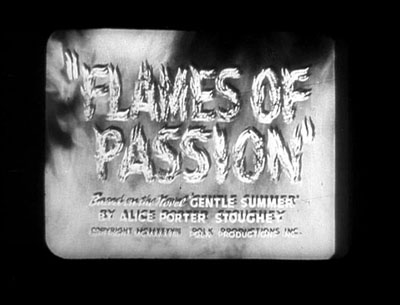
First we see Laura and Alec watching a preview for the made-up film, Flames of Passion, evidently a sort of King Kong epic, which is everything Brief Encounter is not, starting with the exclamation-pointed self-proclaiming adjectives: Stupendous!, Colossal!! Gigantic!!! Epoch-Making!!! All the stuff that is repressed and suppressed in Lean’s film (made and released during World War II, set in 1938) is right out there in Flames; with its restive natives, stampeding elephants, and passionate kisses, it’s so blatant and on the nose that even the typeface for the title is made out of flames.


This movie is definitely fictional, but Flames of Passion has been used as the title of several films, most prominently a 1922 British melodrama and a 1989 gay love story, very loosely based on Brief Encounter.

The following week, they go back to see Flames of Passion, but first, a Donald Duck short. (IMDB identifies it as the 1938, “Donald’s Better Self,” but there’s no way to know for sure, as all we hear are some Donaldian quacks.)


Everybody laughs uproariously at the low comedy, which appears to offer not only relief but a sort of release from the world’s burdens — a familiar motif from Sullivan’s Travels, Sabotage, and Hail, Caesar!. What’s not familiar is the elevated level of Laura and Alec’s analysis, at least to those of us used to in-theater comments on the order of “Don’t go in there, you idiot!” (The screenplay, I should have noted earlier, is by Noel Coward.)

Alec: “The stars can change in their courses, the universe go up in flames, and the world crash around us, but there’ll always be Donald Duck.”

Laura: “I do love him so … his dreadful energy, and his blind, frustrated rages.”

Then the music starts and Alec says, “It’s the big picture now. Here we go. No more laughter. Prepare for tears.”

We see the opening title:

1471727506_05d232abbf_o

A lot to parse there. First, the Roman numerals affirm the year as 1938. The apparent 180-degree transformation of Gentle Summer to Flames of Passion is presumably a sardonic commentary on Hollywood’s tendency to bastardize source material. And (the fictional) “Alice Porter Stoughey” refers to the then prominence of three-named, six-syllabled American female authors, such as Alice Duer Miller, Mary Roberts Rinehart, and especially Olive Higgins Prouty, whose 1941 novel Now, Voyager became the aforementioned hit Bette Davis melodrama the following year. (Prouty was an interesting figure, in part because of her subsequent close relationship with the much younger Sylvia Plath. Wikipedia tells us that she “supported Plath financially in the wake of Plath’s unsuccessful 1953 suicide attempt: Plath’s husband, Ted Hughes, would later refer in Birthday Letters to how ‘Prouty was there, tender and buoyant moon.’ Many, including Plath’s mother Aurelia, have held the view that Plath employed her memories of Prouty as the basis of the character of ‘Philomena Guinea in her 1963 novel, The Bell Jar.“)

Lean and Coward’s final comment on Hollywood is that the next thing we see is Alec and Laura leaving the theater. She says in voiceover narration: “It was a terribly bad picture. We crept out before the end, rather furtively, as though we were committing a crime.”


‘Hail, Caesar,’ ‘Merrily We Dance,’ and ‘Lazy Ol’ Moon’ in ‘Hail, Caesar’

The most purely fun movie I’ve seen in the past five years, or maybe longer, is the Coen brothers’ Hail, Caesar! (2016). It’s got a solid story, good performances, and some hilarious moments, but the really special thing about it is the take on peak-studio-era Hollywood, which combines a very knowing spoof with a very knowing appreciation.

The year is more or less 1951, and the main character is Eddie Mannix (Josh Brolin), who’s based on the real-life Eddie Mannix, for many years a notorious “fixer” at MGM. But the Coens’ Eddie has a grander portfolio: he’s “head of physical production” at (the fictional) Capitol Studios, which involves not only covering up the stars’ imbroglios but managing all details of Capitol’s many offerings, from casting to budgets to editing to locations.

The movie revolves around five in-production Capitol films, all depicted with that knowing mix of spoof and appreciation, and all but one era-appropriate. The eponymous Hail, Caesar: A Tale of the Christ is a religious sandals epic that combines elements of Quo Vadis, The Robe, Spartacus, and Ben-Hur. (The novel Ben-Hur, published in 1880, had the same Tale of the Christ subtitle.) Lazy Ol’ Moon is an “oatuner” — Variety-speak for a cowboy picture, aka “oater,” with music — of the kind Roy Rogers churned out for Republic Pictures through 1950. Jonah’s Daughter is a musical featuring Busby Berkeley-style water ballets, which seems like an odd idea today but was a staple for MGM and Esther Williams, in movies like Million Dollar Mermaid (1952). Channing Tatum channels Gene Kelly (in On the Town and Anchors Aweigh) in “No Dames!”, a sailor production number with a hilarious homoerotic-themed subtext. The only movie-in-movie that seems a bit anachronistic is Merrily We Dance, an arch and “sophisticated” black-and-white comedy of manners, something like Design for Living (1933), directed by an Ernst Lubitsch/George Cukor figure flawlessly played by Ralph Fiennes.

I’ll focus on Lazy Ol’ Moon, Merrily We Dance, and Hail, Caesar, since we view finished footage from those three; for the others, we only see scenes being staged and filmed. We take in Moon at its world premiere, attended by its cowboy star, Hobie Doyle (Alben Ehrenreich), a cross between two cowpokes named Rogers: Will (Hobie is a whiz at rope tricks) and the crooning, six-gun-toting horseman Roy. (The latter, born Leonard Slye, chose “Rogers” as his stage name in honor of one of his heroes, as I learned while writing Will Rogers’s biography.) Hobie’s date, arranged by the studio for the publicity value, is the Carmen Miranda-inspired Carlotta Valdez (Veronica Osario). Here’s the opening, climaxed by Hobie crooning “Lazy Ol’ Moon” (a tune actually sung by R. Rogers in a 1939 picture, The Arizona Kid).


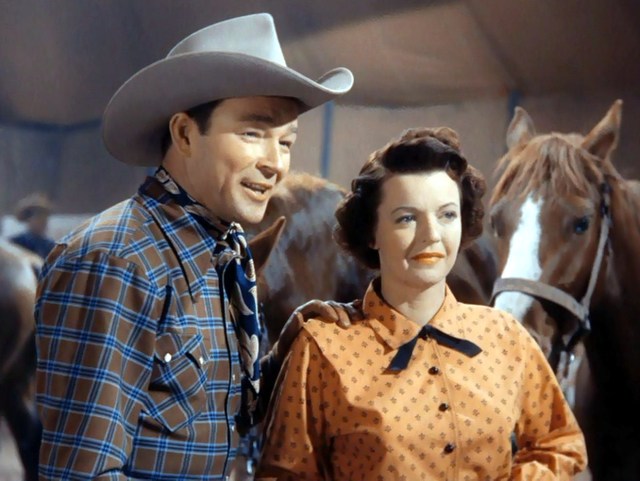
To me, the most striking and somewhat unnerving thing about the scene is the high-contrast color. But it’s true to its models, if not life. As Bill Desowitz observed on IndieWire, for this sequence Hail, Caesar! cinematographer Roger Deakins “emulated the two-strip (red and green) Trucolor process utilized at Republic.” This still of Rogers and his wife, Dale Evans, from Sunset in the West (1950) gives the idea:
roy2

The other notable quality of the Lazy Ol’ Moon scene is how dad-burned ridiculous are the carryings-on of Curly (J.R. Horne, doing his best Gabby Hayes.) But Carlotta and the rest of the audience roar with delighted laughter — an example, as in Preston Sturges’ Sullivan’s Travels (a favorite of the Coens), of the grace of silly comedy. As the narrator (voiced by Michael Gambon) intones, the picture is “another wave of gossamer, another movie, another portion of balm for the ache of a toiling mankind.”

Eddie’s headache vis-a-vis Merrily We Dance is that the head of the studio, the unseen Nicholas Schenk (who actually was the boss of MGM in the early ’50s), decrees that the lead role has to be played by Hobie. It’s a disastrous call, as Hobie and sophistication are polar opposites. After trying to get the lad to make a “mirthless chuckle,” and “trippingly,” “with a certain ruefulness,” say the line, “Would that ’twere so simple,” Laurence Laurentz seems ready to tear out his remaining hairs. But what the boss says goes and the kid stays in the picture.

Eddie goes to visit editor C.C. Calhoun (Frances McDormand) to look at a cut of Merrily on her Movieola, and manages to do so, after a near-Isadora Duncan-type mishap with her  scarf.


Wonder of wonders! Improbably, Hobie’s performance does the trick, even if it doesn’t quite reach Oscar™ proportions. His natural physical grace comes though, and the execrable line “Would that ’twere so simple” has been shortened and improved. And who would have thought it possible — his closing smile is actually rueful. Here’s to the magic of movies.

For the scenes of Hail, Caesar: A Story of the Christ, as Desowitz describes it, the filmmakers mimicked Technicolor epics — “that gold and red look with warm, rich tones.” There are also the matte backgrounds characteristic of the times, which look especially fake today as computer-aided graphics have become more sophisticated. We look on with Eddie Mannix as he watches a rough cut in the studio screening room. George Clooney’s Baird Whitlock (Robert Taylor, kind of) plays the Roman tribune Autolycus; the narrator is the same Michael Gambon.


That missing “DIVINE PRESENCE” remains a problem. Eddie takes a meeting with a rabbi, a minister, a priest and a Greek Orthodox priest to see what sort of representation of the godhead might be inoffensive to them all; the results, perhaps predictably, are a joke. The Coen Brothers didn’t manage to solve the problem either, as we learn at the very end of the movie, seen just as the credits finish rolling. Wedged between thanks to various municipal film boards and assurances that no animals have been harmed is this disclaimer: “This motion picture contains no visual depiction of the godhead.”